

"Then God said, 'Let us make man in our image, in our likeness. And let them rule over the fish of the sea and the birds of the air, over the livestock, over all the earth.'" With those words in Genesis 1:26, the curtain rises on humanity's purpose. The previous verses record what we are — beings stamped with God's own image, carrying a dignity unparalleled in the rest of creation. But the next breath of revelation moves immediately from being to function: from who we are to what we are called to do.
If Genesis 1:26-27 answers the question "what is man?" by lifting humanity to the heights of dignity, Genesis 1:28 answers it by bending humanity to the work of responsibility. We do not merely exist as image-bearers — we are commissioned as image-bearers. And that commission still rings down the centuries, addressed to every human being on the planet.
Two great tasks
God's first words to the man and woman are not abstract theology but a practical job description. "God blessed them and said to them, 'Be fruitful and increase in number. Fill the earth and subdue it. Rule over the fish of the sea and the birds of the air and over every living creature that moves on the ground.'" Two tasks. Populate the earth. Rule the earth.
The first is straightforward — and culturally explosive in its original setting. The peoples of the ancient Near East surrounded marriage and childbirth with fertility rituals, charms, and superstitions, anxiously appeasing the right gods to secure offspring. Genesis sweeps all of that away with a single sentence. Children are a blessing from God's own hand — not the product of magic, ceremony, luck, fate, or the stars. Whether you have children, how many, and when, is held entirely in the perfect will and purpose of the One who made you. Marriage is, among other things, the means by which the earth is filled with more bearers of God's image.
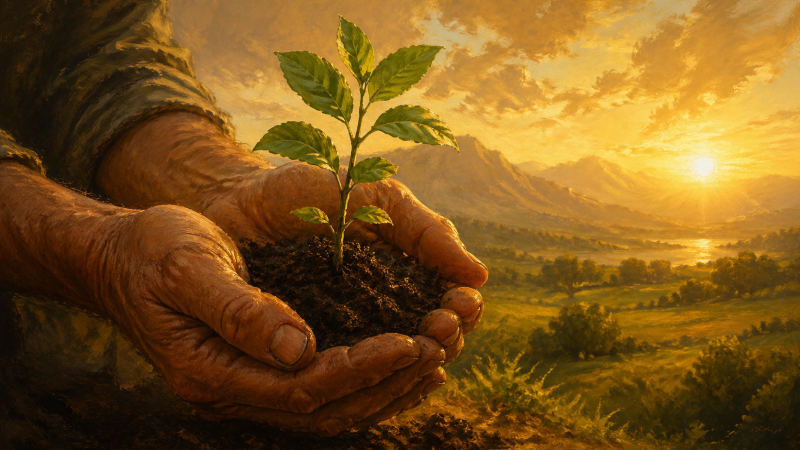
The second task — to rule and subdue the earth — is so important that Genesis states it twice in three verses. Whenever Scripture repeats itself, it is whispering: pay close attention, this matters. Immediately after the creation of human beings comes a coronation. Humanity is crowned king and queen over the planet. What does that crown actually mean? Three things deserve our attention.
A delegated responsibility
This idea has caused trouble. As far back as 1967, the historian Lynn White published an essay in the journal Science blaming this passage for what he called the "raping of the environment" — accusing Genesis of teaching arrogance toward nature. King Charles has called Genesis 1:28 "a license to exploit the environment," contributing to the feeling that the world is ours to dispose of as we please. Many today read this verse as a divine permission slip for plunder.
Nothing could be further from what God actually says. Human rule over the earth is not absolute; it is delegated. We do not own the planet. The Creator does. He has entrusted His handiwork to us, and our authority is borrowed from His. Because we bear His image, our rule is meant to reflect His rule — and God's rule, throughout Scripture, is wise, kind, fair, just, and compassionate.
The very Hebrew word translated "rule" carries this nuance elsewhere in Scripture. In Leviticus 25, masters are commanded not to rule their servants harshly. In Psalm 72, the ideal ruler is the one who champions the poor and defends the disadvantaged. That is the kind of rule God wired into the fabric of creation. Tyrants exploit. Stewards serve. We are managers, not monarchs in our own right — accountable tenants entrusted with the keys to a beautiful and fragile estate.
An abdicated responsibility
Look around, however, and the rule humanity actually exercises bears little resemblance to the rule God commissioned. Greed and grasping have replaced wisdom and stewardship. Landlords charge exorbitant rents for tiny rooms. Forests fall to short-term profit. Oceans fill with plastic. Fallen humanity, instead of caring for creation, tramples and plunders it like a Viking raider looting a town. The crown that was given to bless the earth has too often been used to crush it.
That should grieve every Christian. There is sometimes a temptation, in reaction against extreme forms of environmentalism — the kind that effectively worships the planet — to swing to the opposite extreme and act as though the earth's groaning does not matter at all. Both errors are wrong. The right response is neither idolatry of the planet nor indifference to it, but godly stewardship. Churches that speak out against other forms of sin should also be willing to lament and resist this one. Pillaging God's world is not a neutral act.
A continuing responsibility
Even after the fall in Genesis 3, the crown is not removed. The image of God in humanity has been spoiled by sin, but it has not been erased — and the commission to rule and subdue the earth still stands. This calling is not reserved for politicians, scientists, or the unusually gifted. It is given to every human being, because it flows directly from the dignity of bearing God's image. You have been crowned. You have a part to play.
What does that look like in practical terms? Three things stand out.
Be a good manager of the earth's resources
Stewardship begins at home and in the everyday. Recycle what can be recycled. Conserve energy — turn off lights you are not using, do not boil a full kettle for one cup of tea, do not leave radiators blasting in empty rooms. Drive only when you need to. Choose products that are kinder to the environment when you can, even if they cost a little more. Dispose of waste responsibly.
It is tempting to throw up our hands and ask, "What difference can I possibly make when whole nations churn out trillions of tons of pollution every year?" But God will not hold you accountable at the judgment for what other nations do. The leaders of those nations will answer for their stewardship. You will answer for yours. A tenant in a beautiful new apartment is not free to knock down walls or brick up windows; he must care for what he has been given. How much more for this incredibly delicate ecosystem entrusted to the human race? Be wise rather than naïve — sometimes well-intentioned solutions create unintended harms — but do not let the difficulty of the question excuse neglect of the principle.
Learn as much as possible about God's world
Subduing the earth is not only about restraining its abuse but about understanding it. Every honest field of study is a small slice of dominion. The student grappling with physiotherapy or computer science or literature, the medical researcher untangling a disease, the artist exploring colour and form, the historian piecing together the past — all are mastering a corner of God's creation. The amateur birdwatcher and the keen astronomer are exercising the same calling.
The German astronomer and mathematician Johannes Kepler described his scientific work as "thinking God's thoughts after Him." When he discovered the three laws that governed the motion of the planets, he was tracing patterns God had woven into the universe. The same is true for any discipline rightly pursued — science, music, architecture, politics, theology. The more you know of the world God has made, the more you will see of His glory. Curiosity is not idle; it is part of obedience.
Work hard at your occupation
This is where the calling becomes intensely personal. Whatever your job, however humble or exalted, however thrilling or tedious, that is the patch of earth God has assigned you to rule. Strive to be as good as you can possibly be at it, for the glory of God. That is ruling and subduing the earth.
It might be a student room hardly big enough to swing a cat in — but caring for it well is part of dominion. Picking up a piece of litter is part of dominion. Cleaning a hostel room that was filthy yesterday and will be filthy again tomorrow is, in its small way, bringing order out of chaos exactly as God did at the beginning. A teacher who explains imaginatively, who knows her students as individuals and tailors her teaching to each — even adapting a piece of music from a video game so an autistic pupil will fall in love with the piano — is ruling and subduing the earth. A mother running a well-ordered home, feeding her family with care rather than convenience, sitting with her children rather than parking them in front of a screen, is ruling and subduing the earth. An engineer who designs a bridge that lasts, an architect who builds beautifully and ethically, a farmer who works the land sustainably — every honest calling fits inside this commission.
It does not matter, in one sense, whether the work is glamorous or quiet, paid handsomely or hardly at all. Bin man, doctor, factory worker, pastor, housewife, farmer — every human being made in God's image bears the same dignity and the same responsibility. And the small, faithful work of one ordinary person, in one ordinary place, is more glorious than the world recognises.
A glorious and weighty calling
This is what we were made for. Not to drift, not to consume, not to leave the planet poorer than we found it — but to bear God's image into every corner of His creation, to manage what He has entrusted to us, to learn it, love it, and labour in it for His glory. The ultimate end of every human action — eating, drinking, studying, working — is to glorify God. And one of the chief ways we bring Him glory is by living out this commission: ruling and subduing the earth, in His way, on His behalf, until He returns to put all things right.
It is a glorious responsibility. It is also a weighty one. We will not carry it well in our own strength — but the God who gave the command also gives the grace.
Add comment
Comments