

“What is man that you are mindful of him?” (Psalm 8:4)
It sounds like a simple question. And yet it is a question that fills the modern world with confusion. Who am I? Why am I here? What does it mean to be a human being? Our culture offers some desperately sad answers.
Some say we are merely sophisticated animals who have clawed our way to the top of the evolutionary ladder — soon to be replaced by whatever comes next. Others say we are insignificant specks of matter floating on a little planet in an infinite universe, with no meaning and no significance at all. Others still give up on the question: we cannot know what we are, so don’t lose sleep over it — just inject whatever meaning you can into life before you die.
The reason modern people are so lost on this question is that they have rejected the Bible. But unless our Maker tells us who we are and what we are for, we cannot know. We need him to tell us. So we return to the opening chapter of Genesis to discover the true answer.
The climax of creation
In Genesis 1, human beings are created last — but last here is certainly not least. God deliberately creates us at the very end of the creation week to underscore our importance. The whole narrative has been building steadily toward a climax. Each day gets longer. More is said about each thing God makes. And finally, at the summit of it all, God creates mankind.
Moses flags the significance of this moment in several striking ways.
First, the verb “create” — the Hebrew bara — is used very sparingly through Genesis 1. It appears only three times in the whole chapter. In verse 1, God creates the heavens and the earth out of nothing. In verse 21, he creates conscious life. And then in verse 27, bara reappears — three times over — as God creates human beings. The language is straining to tell us: something altogether unique is happening here.
Second, for the first time in the Bible we hear God consulting with himself before he creates. Up to this point the pattern has been simple: “And God said, ‘Let there be …’ and there was.” But now, the formula changes. “Then God said, ‘Let us make man in our image, in our likeness.’” There is deliberation. Divine counsel. A solemn pause before the final act of creation.
Third, verse 27 is written as poetry. Most Bibles lay it out on the page to reflect its poetic form in the Hebrew — the very first poetry in Scripture. Whether or not you are “a poetry person,” the form itself is shouting: pay attention. The creation of mankind stands apart, because mankind stands apart from the rest of creation.
Made in the image of God
What makes human beings so different? The answer is there in verse 26: “Let us make man in our image, in our likeness.” That is the key. No rock, no tree, no ocean, no animal — not even the holy angels in heaven — bears the image of God. Only human beings do.
But what does it actually mean to be “in the image of God”?
The words image and likeness together describe something that is similar to another thing and often represents it. To say a person is made in God’s image is to say two things at once: you are like God, and you represent God. Genesis 5:3 puts it the other way round: Adam “had a son in his own likeness, in his own image, and he named him Seth.” Seth was like Adam. When people looked at Seth, they saw Adam in him.
Scholars have spilled much ink trying to isolate one single quality — reason, conscience, creativity — as the image of God in man. But the Bible itself refuses to narrow it down. A human being is a body-soul unity, and the image of God covers the whole of who we are. The more we learn about God, and the more we learn about ourselves, the more facets of his image we discover in us.
God is a moral being: he loves righteousness and hates evil. We too have an inner sense of right and wrong that no animal possesses. An animal reacts to fear of punishment or hope of reward — but it does not wrestle with moral conscience the way humans do.
God is spirit. And we are made with an immaterial soul that prays, praises, and worships. You will never find an animal on its knees in intercessory prayer. Worship is a uniquely human thing — because we are uniquely made in God’s image.
God thinks, reasons, knows. We too have minds that rise to abstract thought. Animals can solve simple puzzles, but they do not lie awake pondering the meaning of existence or wondering if there is life after death.
God feels. And so do we — a whole range of emotions, often all at the same time. A father watching his son play football can feel sadness that the team lost, pride that his son played well, thankfulness to God for the gift of a son, and irritation that they’re running late for tea — all at once. That capacity reflects a God of rich emotional life.
God is relational — three persons in perfect love and fellowship from all eternity. And we are made for relationship. That is why loneliness is so painful: we are made in the image of a relational God.
Even physically, in a mysterious way, we reflect him. Not that God has a body or a nose or two eyes — God is invisible. But he sees, and we have been given eyes. He hears, and we have been given ears. He speaks, and we are creatures of speech. He creates beings in his own likeness — and in our own small way, so do we, as Adam did Seth.
Every human being has dignity
To be made in God’s image is to be a living representation of him. When you look at a human being, you see something of what God is like — more clearly than in anything else in all of creation. The youngest child, the oldest person, a disabled human being: each one reflects God. Each one bears his image.
This was revolutionary in Moses’ day. The nations around Israel did believe some people were made in the image of the gods — but only a few. One Mesopotamian text said: “The king, he is like unto the very image of god.” Only kings. Only the powerful, the wealthy, the mighty. A labourer digging a canal, or a mother nursing her child, was nothing special.
Against that elitist background, Genesis thunders a stunning truth: every human being, from the moment of conception, simply because they are human, is made in the image of the God of heaven. Men and women, young and old, rich and poor, black and white — every single person carries an incredible dignity and worth.
Dignity degraded
We are living at a time in history when human dignity is being degraded as never before. Worth is measured by earning power. Respect for the sanctity of life is rapidly diminishing. We have seen the bitter fruit of abortion. The dignity of the elderly is being stripped away as they are shuffled off to nursing homes, sedated, and parked in front of televisions so as not to inconvenience anyone. Assisted suicide inches steadily closer.
Each one of these people is made in the image and likeness of God. Each has a dignity unparalleled by anything else in the universe.
Do you realise how significant you are — because you are a human being? Do you realise it about the people around you? Every person you will meet this week is a man, a woman, a boy, or a girl, made in the image and likeness of God. When the Creator wanted to make a being more like himself than anything else in the universe, he made you. The stars and the mountains, the oceans and the angelic host, are remarkable — but you and I are more like God than all of them put together. Human beings are the apex of creation.
Marred, but not obliterated
Of course, we all know that human beings often fail to reflect God. Far too often we think and speak and act corruptly. This is because the image of God in us has been vandalised by sin.
But the Bible is clear that even after the fall, human beings are still made in God’s image. Long after the fall, long after the flood, God said to Noah: “Whoever sheds the blood of man, by man shall his blood be shed; for in the image of God has God made man” (Genesis 9:6). That is why murder is such a serious offence — not because of anything the victim did, but because of what he is: an image-bearer of God.
James 3:9 says the same: “With the tongue we praise our Lord and Father, and with it we curse men, who have been made in God’s likeness.” Even fallen humans still bear that likeness.
This matters as we engage with people who disagree with us — sometimes offensively, even blasphemously. We may hate what they are saying. But they are still made in the image of God. For that reason — not because of their beliefs, but because of what they are — they deserve to be treated with respect and dignity.
The image has been corrupted, but it has not been destroyed. Read the poems and novels of unbelievers, listen to their songs, talk with your non-Christian friends — and you will see traces of the image of God everywhere. A broken, vandalised, boarded-up building can still give you a hint of its former glory.
And how many of our fellow human beings are living sub-human lives. It is a sad thing to speak with someone made in the image of God — created for immeasurable dignity and worth, made to know and worship the living God — and to discover that the only thing that really lights them up is the newest box set on Netflix, or the weekend’s football match, or the next drink, or the next hook-up. You are made for so much more than that.
The image restored
That is why the gospel is such good news. Jesus Christ is restoring the image of God in his people. Paul writes of the new nature “which is being renewed in knowledge after the image of its Creator” (Colossians 3:10). And in Romans 8:29, he tells us that God saved us precisely so that we might be conformed to the image of his Son.
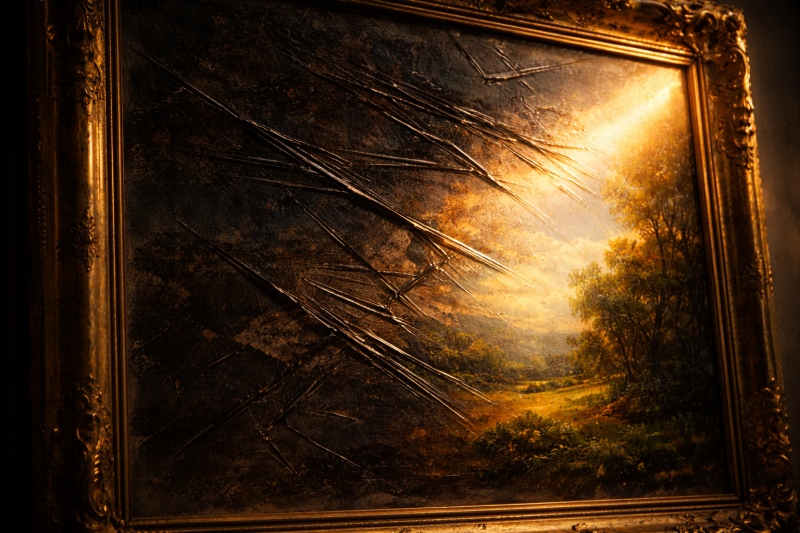
There is a famous painting by Rubens in the chapel of King’s College, Cambridge — a vibrant masterpiece by one of the greatest artists who ever lived. In the 1970s, it was vandalised in the dead of night. Words were scored into its surface. The painting was taken away, and in its place a small notice was put up: “It is believed that this masterpiece can be restored to its original condition.” It was painstaking work. It took a very long time. But little by little, the masterpiece was brought back to what it once was.
That is a good picture of what God is doing in the life of every Christian. Sin has vandalised his image in you and me. We are not what we should be. But God is slowly, masterfully, wisely, kindly, lovingly restoring his image in us. And one day — one day — we will be perfectly restored. The image of God in each of us will be a perfect representation, a perfect likeness of God in us and in one another.
Add comment
Comments