

What happens when people turn their backs on God?
We might expect Genesis to describe immediate chaos: a society with nothing admirable, collapsing under uninterrupted violence. Genesis 4:17–26 gives a more complicated and recognisable picture. Cain's descendants build cities, develop commerce, make music and master metalwork. They achieve remarkable things. Yet the same culture produces Lamech, a man who boasts about killing someone over a minor injury.
The world without God is capable of great material success and terrible moral failure at the same time. That tension helps us understand the society around us and our own hearts.
East of Eden
After murdering Abel and receiving God's sentence, Cain “went out from the Lord's presence and lived in the land of Nod, east of Eden” (Genesis 4:16). Nod means wandering. It is a fitting name for life away from God: busy, sometimes impressive, but without an ultimate home or purpose.
The eastward movement matters in Genesis. Adam and Eve were driven east from Eden, away from the place of God's special presence. Human rebellion continues moving in that direction until God calls Abram to travel west in Genesis 12. Cain's family belongs to the line of the serpent promised in Genesis 3:15, set against the line of the woman.
The contrast with the earlier part of Genesis 4 is striking. God is present or mentioned repeatedly in verses 1–16. In the account of Cain's descendants through Lamech, he is not acknowledged at all. Children are born, cities rise and discoveries are made, but no one gives thanks. This is not a world from which God is truly absent. It is a world that receives his gifts while ignoring the Giver.
A world of material success
Cain marries, and his wife gives birth to Enoch. Family life continues as a good gift of God, even among those who do not honour him. Cain also builds a city and names it after his son. The man condemned to wander tries to establish permanence and security for himself.
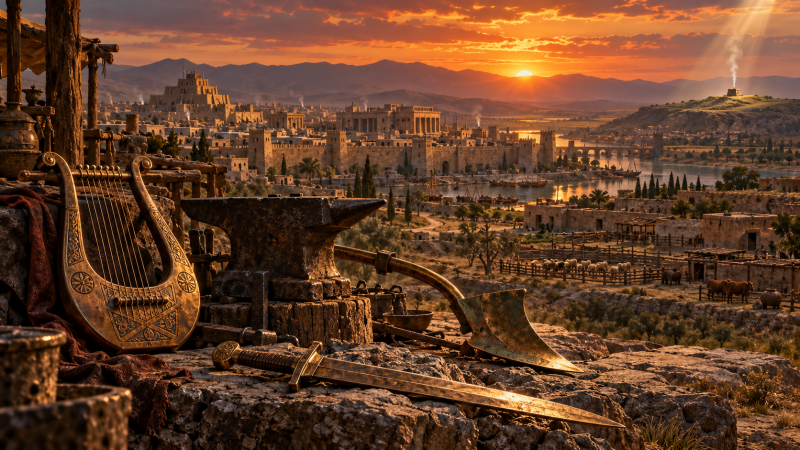
Several generations later, three sons of Lamech stand out. Their similar names, Jabal, Jubal and Tubal-Cain, are associated with production. They are active, inventive men whose work shapes civilisation.
- Jabal becomes the father of those who live in tents and raise livestock. His work points to larger-scale herding, transport, trade and organised economic life.
- Jubal becomes the father of musicians who play stringed and wind instruments. Here culture and the arts begin to blossom. Music is not necessary for bare survival, but it gives shape, beauty and joy to human life.
- Tubal-Cain forges tools from bronze and iron. His craft opens the way for technology, industry, engineering and scientific development.
These are real achievements, and Scripture does not dismiss them because the inventors belong to Cain's line. Human beings remain God's image-bearers, though sin has damaged that image. They still exercise creativity, reason and skill. They still carry out parts of the command to fill the earth and subdue it (Genesis 1:28).
That pattern has continued through history. Pagan Babylon made advances in mathematics and astronomy. Ancient Greece produced philosophy, drama, literature and architecture that are still studied. Roman engineering served cities for centuries. Modern societies have discovered DNA, developed flight, built instant global communication and sent spacecraft beyond the earth.
Christians should not sneer at these accomplishments. All truth is God's truth, and every useful discovery depends upon abilities, materials and order that he supplies. Electricity lights our homes and churches. Medicine relieves suffering. Vehicles, printed books and digital tools serve countless good purposes. Much of this work has been done by people who did not consciously intend to serve God, yet in his providence their work benefits others, including his church.
Jesus says that the Father sends rain on the righteous and the unrighteous (Matthew 5:45). Theologians often call this common grace: God's generous restraint of evil and his distribution of gifts throughout humanity. Common grace explains why unbelieving cultures can produce beauty, knowledge and social order.
It does not, however, reconcile anyone to God. A Nobel Prize, a brilliant invention or an exquisite piece of music cannot atone for sin. Human achievement may improve life east of Eden, but it cannot bring us back into God's presence.
A world of moral failure
Lamech exposes the other side of Cain's civilisation. The alarm sounds first in Genesis 4:19: “Lamech married two women.” He rejects God's pattern of one man and one woman, replacing covenant faithfulness with an arrangement shaped by his own desires.
Then Lamech performs a poem for his wives:
“I have killed a man for wounding me,
a young man for injuring me.
If Cain is avenged seven times,
then Lamech seventy-seven times.”
As literature, it is skilful. It uses rhythm, balance and memorable lines. Its content is savage. Lamech claims to have killed a young man, perhaps even a boy, for causing a comparatively small injury. The punishment bears no proportion to the offence. Worse, Lamech feels no remorse. He turns murder into a song of self-glory.
He also mocks God's words concerning Cain. God had warned that anyone who killed Cain would suffer sevenfold vengeance. That was God's restraint upon private revenge. Lamech grabs the language for himself and boasts that his vengeance will be seventy-sevenfold. He speaks as if he were his own god, judge and executioner.
Sin is gathering speed. Adam and Eve take forbidden fruit. Cain murders his brother. Lamech celebrates bloodshed and threatens vastly multiplied revenge. The line leads towards Genesis 6, when the inclinations of the human heart are described as evil continually.
Cain's civilisation can control animals, shape metal and compose music, but it cannot control the human heart. That contradiction remains with us. We can send a machine to Mars but cannot eliminate violence, addiction or racism. We split the atom and then build weapons capable of destroying cities. The internet carries Scripture across continents and also distributes cruelty, deception and pornography. Artificial intelligence can help people learn, communicate and solve difficult problems; it can also assist cheating, exploitation and manipulation.
Technology magnifies human intention. It cannot purify it. Education may sharpen the mind, culture may refine the taste, and law may restrain behaviour, but none can give a new heart. We cannot civilise our way back to Eden.
Neither contempt nor naïveté
Genesis 4 protects us from two mistakes in our relationship with the surrounding culture.
The first is contempt. Unbelievers are not incapable of insight, beauty, courage or useful work. Christians should receive good gifts with thanks to God, learn from genuine expertise and honour work that serves our neighbours. The image of God, though marred, has not been erased.
The second mistake is naïveté. Material progress is not moral progress. A more educated, prosperous or technologically capable society is not necessarily kinder or holier. Every human achievement can be bent towards pride, domination and self-worship. Cain's city may be sophisticated, but it still lies east of Eden.
This tension also keeps Christians humble. The conflict is not simply between bad people outside the church and good people within it. Remaining sin still produces contradictions in believers. Our only hope is the intervention of God, who gives rebirth and renewal by the Holy Spirit.
A seed God preserves
The chapter ends with two rays of hope. First, Eve gives birth to Seth and says, “God has granted me another child in place of Abel, since Cain killed him” (Genesis 4:25). The word translated child is literally seed. Cain had killed Abel and seemed to have extinguished the faithful line, but God preserved the seed of the woman.
The promise cannot be murdered out of history. Again and again, Satan attempts to destroy the people through whom God's salvation will come. Again and again, God keeps his covenant purpose alive. Seth's birth ultimately belongs to the long road towards Jesus Christ, the promised offspring who crushes the serpent's head.
Cain's earlier judgment showed both God's justice and his restraint. The Sentencing (Genesis 4:11–16) traces that uneasy mixture of exile and temporary mercy. The closing verses of the chapter now show that the future of salvation never rested on Cain's willingness or strength. God himself keeps the line of promise.
A people who call on the Lord
The second ray of hope comes in the final sentence: “At that time people began to call on the name of the Lord.” Public worship appears in the middle of the city of man.
Cain's descendants are busy building, producing and boasting. Meanwhile, God builds another city: a people who trust him, worship him and bear his name. Human history becomes a tale of two cities. The city of man seeks life apart from God. The city of God lives by his promise.
The worshipping community may look small beside the wealth and influence of the surrounding world. Its security does not lie in numbers. Christ promises to build his church, and the gates of Hades will not overcome it (Matthew 16:18).
The world without God can build astonishing things, but it cannot save itself. Our hope comes from beyond the city of man: the God who preserves his people, changes human hearts and brings wanderers home.
Add comment
Comments