

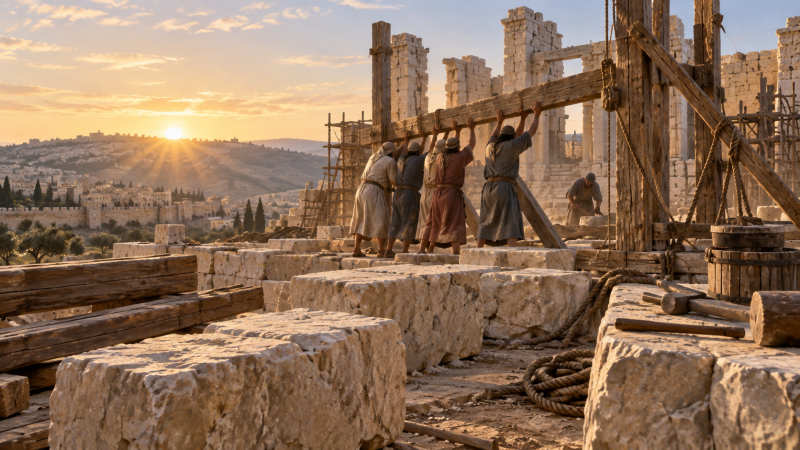
Some parts of the Bible are easy to overlook. Haggai is only two chapters long and sits among the final books of the Old Testament, between Zephaniah and Zechariah. Many Christians can turn quickly to Romans or Genesis but would need the contents page to find Haggai.
Its size is deceptive. Haggai speaks to a discouraged people who have begun to accept spiritual neglect as normal. They once had great plans for God's work, but opposition, tiredness, and the pressure of ordinary life pushed those plans aside. Sixteen years passed. Then God's word broke the silence: "Build the house" (Haggai 1:8).
That command belongs to a particular moment in Israel's history, yet it still confronts the church. It asks what place God's people, worship, and mission truly occupy in our lives.
A short book worth hearing
The last twelve books of the Old Testament are called the Minor Prophets. Minor means shorter, not less important. Haggai contains only thirty-eight verses, but the Holy Spirit included every one of them in Scripture. As 2 Timothy 3:16 says, "All Scripture is God-breathed and is useful for teaching, rebuking, correcting and training in righteousness."
Neglected passages often expose neglected duties. Haggai is especially useful for a church that wants to grow, not merely in attendance but in holiness, love, knowledge, prayer, and witness. Books about church growth are plentiful. Haggai gives us God's own diagnosis of a stalled work and God's way of stirring his people again.
The moment: return, resistance, and delay
Haggai cannot be understood without the ruins of Jerusalem in the background. In 586 BC, Babylon captured the city, destroyed Solomon's temple, and carried much of the population into exile. God had warned Judah through the prophets for generations, but the people would not listen. The fall of Jerusalem was not an accident of politics. Daniel 1:2 says that the Lord gave the king of Judah into Nebuchadnezzar's hand.
Judgment was not the end of the story. Ezekiel saw a valley of dry bones coming to life and heard God promise to bring his people back to their land (Ezekiel 37:12). Jeremiah said the exile would last seventy years. Long before Cyrus was born, Isaiah named him as the ruler God would use to release the captives (Isaiah 45:13).
In 539 BC, Babylon fell to Persia. Cyrus allowed the Jews to return and rebuild the temple, even supplying resources for the work. A small remnant went home with high hopes.
Reality was harder. Land claims were tangled, farms had fallen into disrepair, and neighbouring peoples resisted the rebuilding. The work stopped. The returned exiles directed their time, money, and energy toward their own homes instead. What began as a response to genuine opposition slowly became a settled habit. For sixteen years, the temple remained unfinished.
That is where Haggai begins in 520 BC. The people have not openly rejected God. They have simply learned to live with his house in ruins.
The man: a messenger who points away from himself
We know very little about Haggai. His name may mean "my festival," perhaps suggesting that he was born on one of Israel's feast days while his family lived far from Jerusalem. He likely returned from Babylon with the first wave of exiles. Beyond that, Scripture tells us almost nothing about his background.
The lack of biography is fitting because Haggai's attention is fixed on his calling. Seven of the eleven Old Testament references to him connect his name with the word prophet. Throughout the book, he repeats phrases such as "the word of the Lord came", "declares the Lord", and "says the Lord Almighty". Variations of this messenger formula appear twenty-nine times in thirty-eight verses.
Haggai does not want admiration for his personality. He wants obedience to God's word. After nearly twenty years without a prophet in Jerusalem, the silence is broken. The living God addresses his people again.
His language is direct: consider, be strong, work, build. Scripture still speaks with that authority. Hebrews 4:12 calls God's word living and active. Reading Haggai is not an exercise in religious archaeology. God addresses the complacency, excuses, and misplaced priorities of his church today.
The message: build the house
"Go up into the mountains and bring down timber and build my house, so that I may take pleasure in it and be honoured." (Haggai 1:8)
The returned exiles had started well. When resistance came, their enthusiasm drained away. Delay became normal, and normal became acceptable. Eventually they could pass the unfinished temple without a troubled conscience. Their own houses absorbed the attention that once belonged to God's house.
The temple mattered because of what it represented. It was the visible sign of God's presence among his people. In Exodus 25:8, God said, "Have them make a sanctuary for me, and I will dwell among them." At the dedication of Solomon's temple, he promised to put his name there and said, "My eyes and my heart will always be there" (1 Kings 9:3).
Leaving the temple in ruins therefore said something about Israel's attitude toward God himself. They were willing to live without the sign of his presence at the centre of their life.
The temple also concerned God's honour before the nations. Jerusalem was known as the place where the Lord had set his name. Its ruined sanctuary suggested that Israel's God did not matter even to his own people.
It also stood within God's promise of the coming Messiah. Malachi 3:1 looked forward to the day when the Lord would come suddenly to his temple. The neglected building was tied to a neglected hope: the promised Deliverer who would come to save.
The meaning: a house made of living stones
Haggai's command does not send Christians to Jerusalem to construct another stone temple. The New Testament shows how the old temple reaches its fulfilment in Christ and his people.
Jesus is the chief cornerstone. Those who come to him are "like living stones ... being built into a spiritual house" (1 Peter 2:4-5). Ephesians 2:20-22 describes the church as a holy temple in which God lives by his Spirit. Paul tells the congregation in Corinth, "You yourselves are God's temple and God's Spirit dwells in your midst" (1 Corinthians 3:16).
The church is not chiefly a building, organisation, or weekly event. It is the people Christ has joined to himself and to one another. To build the house now is to build up the church of Jesus Christ.
Our attitude to the church reveals something about our attitude to Christ. We cannot love the Bridegroom while despising his bride, or claim devotion to the cornerstone while neglecting the living stones he is joining together. The church is often imperfect, tiring, and costly to serve. It is also central to God's purpose and precious to his Son.
How the church is built
Ephesians 4:12-16 says that the body of Christ grows as each part does its work. Building the house is not reserved for ministers, elders, or especially visible Christians. Every believer is a living stone with a place in the work. Some service is public. Much of it is quiet and easily missed. None of it is dispensable.
The church is built as Christians devote themselves to the ordinary means God has appointed:
- God's word: hearing it, learning it, obeying it, and helping one another grow into maturity.
- Fellowship: carrying burdens, offering practical care, and loving one another when love requires effort.
- Prayer: asking the Lord to do what activity and clever plans cannot accomplish. "Unless the Lord builds the house, the builders labour in vain" (Psalm 127:1).
- Witness: taking the good news of Christ beyond the church's walls and asking God to add those who are being saved.
These are not glamorous strategies. They are the steady work through which Christ builds his church. The related message The means of grace and peace explores the place of prayer, faithful teaching, fellowship, and mutual encouragement in that work.
Building is demanding. It takes time, energy, money, patience, and a willingness to keep going through setbacks. Haggai does not pretend otherwise. The answer to fatigue is not to accept the ruins. It is to listen again when God speaks, trust his presence, and return to the work he has given us.
It is not too late to begin again
The people had neglected the temple for sixteen years, but God had not finished with them. He exposed their excuses, stirred their spirits, and called them back. They listened. Within weeks, the work began again.
That is good news for a church or a Christian who has grown comfortable with neglect. God's rebuke is an act of mercy. He speaks because he intends to wake his people, reorder their loves, and set their hands to useful work.
Haggai will go on to teach how God's people can face discouragement and opposition, and where they find strength to continue. His assurance to a weary remnant remains precious: "I am with you" (Haggai 1:13). That same promise also stands behind the call to serve in the church today.
The house belongs to God, the strength comes from God, and every one of his people has work to do.
Add comment
Comments