

There is a verse tucked away in the book of Judges that should shake every Christian household. It comes just after the conquest of Canaan, after Israel had walked between the parted walls of the Red Sea, eaten the bread of angels, drunk water from the rock, and watched the walls of Jericho collapse at the trumpet blast. And then this: “After that whole generation had been gathered to their fathers, another generation grew up, who knew neither the Lord nor what he had done for Israel” (Judges 2:10).
One generation. That is all it took.
The gospel is only ever one generation away from extinction, and Psalm 78 was written to make sure that does not happen. Asaph opens with a summons — “O my people, hear my teaching” — and what follows is not a private devotional but a public charge laid on every parent, grandparent, and member of the covenant community. He gives us, in compressed form, two answers to two questions. What are we to pass on to our children? And why?
The Wonders Worth Telling
The first thing parents are to hand on, Asaph says, is history. Not the kind of dry, sterile history that turns school pupils against the subject for life, but the praiseworthy deeds of the Lord, his power and the wonders he has done (v.4). The Hebrew word translated “wonders” is reserved in Scripture for acts that only God can do. You could travel to the farthest edge of the observable universe and never see anything to rival them.
Asaph then practises what he preaches. He rehearses the catalogue. The Red Sea split open, with walls of water on either side and a dry road through the middle for two million people. The pillar of cloud by day and fire by night. Water gushing from a rock in the desert — not a trickle, but as abundant as the seas. Manna falling from the sky for forty years. The conquest of nations. Judgement on Egypt. Mercy on a people who deserved none.
And all of this is only the trailer. If Asaph thought the Exodus deserved to be told and retold, what would he say about the New Testament? About the Son of God taking flesh in the womb of a peasant girl from Nazareth? About the storm silenced with a single word, the dead raised with a touch, the demons cast out by the thousand? About the Lamb struck down on a Roman cross, bearing in his body the plagues of God for his people — not to deliver them from Egypt, but from sin and hell and Satan himself? About the empty tomb on the third day, the ascension, the Spirit poured out on all flesh, and a global church gathered from every nation?
What would Asaph say about the resurrection of Christ if he could have seen it? And what could be more tragic than children who know more about the 1916 Rising than the rising of Christ on Easter morning? More about the Irish famine than the famine that brought Joseph’s brothers to their knees? More about the geography of South America than the geography of the Old Testament? More about Harry Potter than the Lord of glory?
We must never give our children the impression that anything in the world is more wonderful, more exciting, or more important than the praiseworthy deeds of the Lord.
The Statutes Worth Teaching
The second thing Asaph names is God’s law. He decreed statutes for Jacob and established the law in Israel, which he commanded our forefathers to teach their children (v.5). Notice the word “commanded”. This is not a polite suggestion. It is not optional, not something to fit in around the edges of a busy life. It is a duty laid by God himself on every Christian parent.
Parents are very good at teaching their children the laws of the land so they will not get into trouble. They are even better at teaching them the laws of the playground so they will not be embarrassed in front of their peers. But how much thought and time and energy goes into teaching the standards of the Christian life? The Ten Commandments. The call to love one’s neighbour. The call to love one another deeply. To forgive as we have been forgiven. To honour the Lord’s day. To read the Scriptures together as a family. To pray.
This is the chief responsibility of parents. The church is here to help — with Sunday school, with youth work, with preaching that reinforces what is taught at home — but the primary classroom is the family. The vow taken at a child’s baptism is not a polite formality. It is a solemn promise to teach. And there are few forms of neglect more devastating than the neglect of Christian parents who never teach their children the deeds and laws of the Lord. The wounds it leaves do not last a few years — they last for ever.
Why It Matters
So much for the what. Asaph then gives us four reasons for the why.
First, so that they will know. God does not download truth into our children’s heads like a scene from The Matrix. They will not absorb the gospel by spiritual osmosis. If we do not tell them, they will not know. The pattern of fallen human nature is depressingly consistent: the first generation has the gospel, the second generation assumes the gospel, and the third generation loses the gospel. Never assume.
Second, so that they will tell it to their children. Each generation is a link in a chain that stretches back to Eden and forward to glory. The truth of God is meant to be passed on with passion, not preserved like an exhibit in a museum. Children catch the enthusiasm of their parents. Whatever a parent is excited about — football, music, food — tends to rub off on their children. Are you passionate enough about Christ that your children might catch it from you?
Third, so that they will trust the Lord (v.7). This is not an academic exercise. The aim is not children who can win a Bible quiz, but children who set their hope in God. The promise is for them and for their children, but the promise must be received. Covenant privilege is not the same as personal faith. A child can be raised in church, baptised, catechised, and well behaved, and still be far from Christ.
Fourth, so that they will obey his commands. The end of all teaching is a transformed life. Knowledge that does not produce holiness has failed. We want our children not only to believe but to walk, to serve, to obey — to be as holy as redeemed sinners can be.
A Generation That Had Everything
The rest of Psalm 78 hangs over the opening verses like a warning storm. Asaph rehearses, at length and in painful detail, the story of the wilderness generation — a generation soaked in privilege. They walked between the walls of the sea. They ate the bread of angels. They drank from the rock. They saw the Egyptian army drowned. They were baptised, Paul says, into Moses in the cloud and in the sea.
And then this: they did not believe in God or trust in his deliverance (v.22). In spite of his wonders, they did not believe (v.32).
It is possible to know everything and to believe nothing. It is possible to have every advantage and to be lost. This must never be far from our minds as we teach our children. The aim is not behaviour modification or cultural Christianity. The aim is the heart. And only the Spirit of God can change a heart — which is why every lesson, every conversation, every family prayer should be offered up with the cry that our children would not merely hear the wonders of the Lord, but would trust the Lord of those wonders.
The Weak Link
Every generation is a link in the chain. The question Psalm 78 quietly puts to each of us is this: will I be the link that holds, or the link that breaks?
Will our descendants, a hundred years from now, name Christ as Lord because we did our part? Or will they be the children of Judges 2:10 — another generation that grew up knowing neither the Lord nor what he had done?
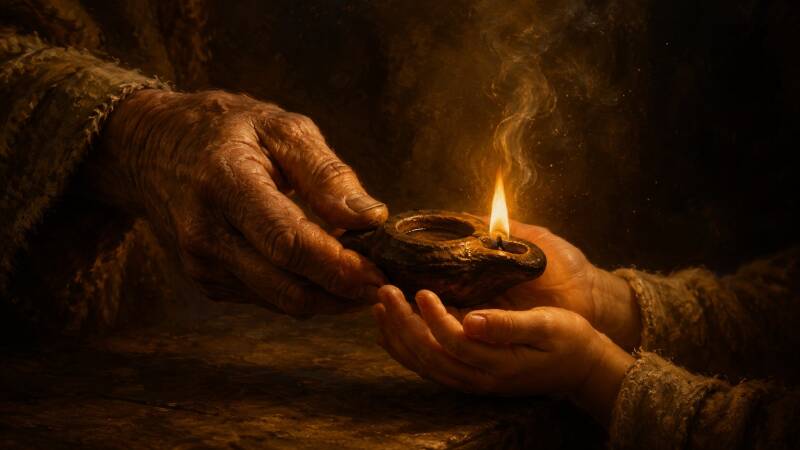
It does not really matter what else we leave behind. Property and money and academic brilliance and sporting trophies will burn. What matters — what matters more than any other inheritance any parent can ever leave — is the gospel light passed from one trembling hand to the next.
What good is it for a man to gain the whole world, and yet lose his very soul?
Add comment
Comments