

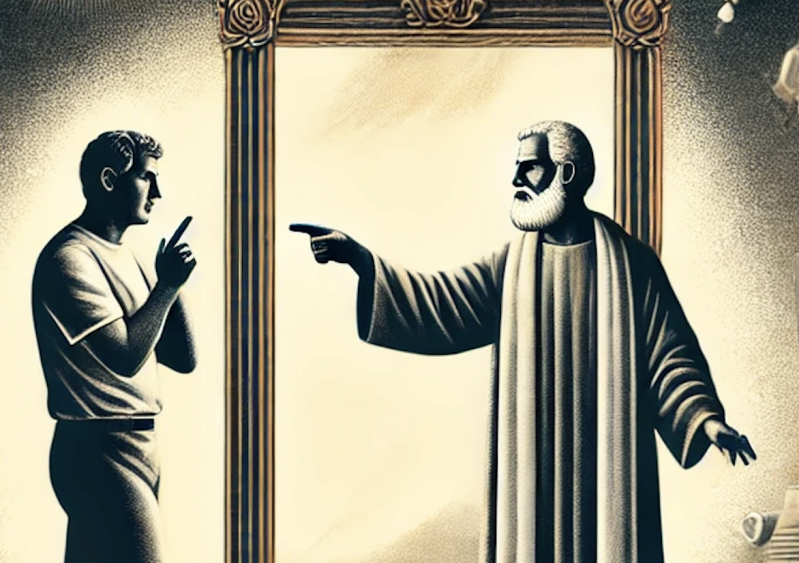
Remember being in school when the teacher was scolding someone for a terrible test result — and you were sitting there feeling safe and smug, confident you had done well? Then suddenly the teacher turned to you and let fire, because it turned out your performance was dismal too. Something very like that is happening in Romans 2. Paul has spent the second half of chapter 1 denouncing the openly immoral pagan, and it is as though someone has been standing beside him the whole time, nodding vigorously in agreement. Now, in chapter 2, Paul turns on this imaginary bystander and says: "You therefore have no excuse." In this sermon, we discover that the decent, moral, upstanding citizen is just as guilty before God as the flagrant sinner — and that four common excuses for self-righteousness crumble under the weight of God's truth.
When Paul Turns on the Bystander
Throughout Romans 1:18-32, Paul has been building his case against the immoral pagan — people living in flagrant godlessness and wickedness. But all along, someone has been standing beside him, nodding vigorously: "Quite right, Paul! Absolutely! You tell them — this behaviour is shameful, wicked, horrible!" Now, in chapter 2 verse 1, Paul suddenly turns on this imaginary bystander: "You therefore have no excuse, you who pass judgment on someone else." The phrase "no excuse" is exactly the same word Paul used in chapter 1 verse 20 about the openly immoral. The moral man has no more excuse than the pagan.
Who is this second category of person? These are decent people with conservative values. In today's language, they share many of our convictions — that marriage is between one man and one woman for life, that family life matters, that the unborn child should be protected, that hard work and honesty are important. Not all pagans fitted the description in chapter 1. The Romans in Paul's congregation would all have known the name Seneca — the famous political leader, philosopher, and tutor of the emperor Nero. One scholar describes Seneca as a man who exalted the great moral virtues, exposed hypocrisy, preached the equality of all human beings, and assumed the role of a moral guide. Seneca was an outstanding, upright, decent human being — a pagan, but a moral one. He would have agreed with everything Paul said in chapter 1.
But Paul's argument is building toward a devastating conclusion: there is no one righteous, not even one. Not just the obviously depraved, but the outwardly decent as well. In chapter 2, Paul turns from ugly sin to subtle sin, from open flagrant sin to hidden secret sin. And he dismantles four excuses that the moral person uses to convince themselves they don't need God's righteousness.
Excuse 1: "I Disapprove of Immoral Behaviour" (verses 1–4)
Three times in these verses we are told that this person "passes judgment." This is not mild distaste — it is strong moral condemnation. This man thinks sexual immorality, homosexuality, murder, and deceit are wicked and deserve God's judgement. And because he denounces these things, he seems to think he will escape judgement himself.
Paul's response cuts to the heart: "You who pass judgment do the same things." You may not do them in the same way, to the same degree, or openly in broad daylight. You may do them secretly and politely, so that no one would ever suspect. But you do them nonetheless. You are on the same spectrum.
It is easy to condemn the junkie or the alcoholic lying drunk at the side of the street — and to think, "What a pathetic man. Glad I'm not like that." But is your self-control above reproach? Maybe it's not alcohol, but what about food, or social media? One of our girls was telling us about a teacher so addicted to Candy Crush she was playing it in the middle of class instead of teaching. Or maybe it's coffee — if you don't get your morning cup, you're grumpy and irritable. Or maybe it's television, or work you simply cannot switch off from. We are all somewhere on the spectrum of addiction.
It is easy to condemn a murderer and think, "I would never do such a hateful thing." But how many malicious, hateful, murderous thoughts are you hiding behind that polite exterior? All you have to do is read the comments on any social media discussion thread, and it doesn't take long before the most hateful bile starts pouring out. Or think of road rage — a perfectly decent person transformed into a monster because someone drove badly in front of them. It is a horrible window into the boiling rage seething just under the surface of any one of us.
This is what Jesus taught in the Sermon on the Mount: if you hate in your heart, you have committed murder in your heart; if you look lustfully, you have committed adultery in your heart. It may not be as bad as doing it physically, but it is still sin — the very sin you are condemning in others. Don't think that your disapproval of immoral behaviour will render you immune to God's judgement.
Excuse 2: "God Isn't Angry with Me" (verses 4–5)
Paul showed in chapter 1 that God's wrath is revealed by handing sinners over to their own destructive desires. The worst thing you could do for an alcoholic is give them ten cases of whiskey — you would be handing them over to their own desires, ensuring they destroy themselves. That is how God's wrath was expressed against the immoral pagan.
But the moral man looks at his own comfortable life and thinks: "God hasn't handed me over to a depraved mind. I have a loving, stable marriage, a happy family, a beautiful home. I'm holding down a good job, paying my taxes, even giving to charity. There's not a whiff of wrath in my life. God is obviously angry with those people — but not with me."
Paul's answer in verse 4 is devastating: "Do you show contempt for the riches of his kindness, forbearance and patience, not realising that God's kindness is intended to lead you to repentance?" You are experiencing God's kindness and patience — but that does not mean He isn't angry with you. It means He is giving you a chance to repent. You are meant to look at your sin on one hand and God's kindness on the other, and run to Him in repentance.
Instead, verse 5, you are "storing up wrath against yourself for the day of God's wrath." Every day you go on without repenting, every kindness you take from God without worshipping Him — you are saving up more and more wrath for yourself. God may not be revealing His wrath against you now the way He is with the people in chapter 1. But you are running up a huge tab that will be presented for payment on the last day. What a fearful thought.
Excuse 3: "My Track Record Will See Me Through" (verses 6–8)
This man thinks he is good enough for God. But Paul warns: God does not judge us on the basis of what we say, but on the basis of what we actually do. Verse 6: "God will repay each person according to what they have done."
So what kind of life must you live? Verse 7: "To those who by persistence in doing good seek glory, honour and immortality, he will give eternal life." Does that describe you? Have you lived every moment of your life for God's glory, loving Him with all your heart, soul, mind and strength, loving your neighbour as yourself, seeking at every moment to do and say and think and feel only what is good, pure, and right?
So many decent people say, "I don't do anybody any harm." But Paul says it is not just about not doing harm — it is about positively doing good, to the right extent, for the right motives, at every moment of your life. If that honestly describes you, then you have nothing to worry about. But it does not describe you, or me, or anyone — except Jesus Christ.
Instead, verse 8 describes us: "those who are self-seeking and who reject the truth and follow evil — there will be wrath and anger." That is what we are all like by nature: self-seeking, truth-rejecting, evil-following. And just because we don't do it openly and brazenly like the people of chapter 1 doesn't mean it doesn't count.
Imagine if we were to play on a screen, for everyone to see, just a typical week of your life — not a particularly bad week, just an ordinary one — accompanied by the soundtrack of your inner thoughts. There would be much to be thankful for, but there would be so much to be ashamed of. You could never show your face in public again. The track record of your life will not save you — it will judge you and condemn you.
Excuse 4: "I've Never Read the Bible" — or — "I Read the Bible" (verses 12–15)
Some say: "God can't hold me accountable — I've never read the Bible, never gone to church, never heard of the Ten Commandments." Paul answers this in verses 14-15: human beings are made in the image of God, and part of what that means is that you have a sense of right and wrong hardwired into your soul. You have a conscience. It doesn't work perfectly — nothing in us does — but it works most of the time. When someone tells a lie, breaks a promise, or takes what doesn't belong to them, they feel bad about it. Their conscience speaks.
It does not matter whether you go to the deepest jungle in the Amazon or the concrete jungle of any city — every human being you meet has a moral code, broadly reflecting God's law, because they are made in God's image. But here is the point: nobody meets even their own standards. Everyone breaks their own law. Never mind God's standards — we don't even live up to our own. We are guilty on our own terms.
Others say: "I'll be fine because I have read the Bible — I know it well." Paul answers this in verse 13: it is not about how well you know the Bible. The question is whether you are obeying it. It is like a burglar hoping to avoid prison because he can stand up in court and recite the laws of Ireland from start to finish. It won't save him — in fact, it makes him all the more guilty, because he clearly knows the law and doesn't obey it.
Depressing News That Prepares for Glorious News
This is a depressing picture, and it is not the sort of thing modern people appreciate. We want our self-esteem boosted, not crushed. But Paul is deliberately making us feel bad about ourselves — because we need to realise we are terminally ill before we will be ready for the good news of the cure. It is not just the brazenly immoral people of chapter 1 who have no righteousness; the outwardly decent, upstanding citizens of chapter 2 cannot save themselves any more than the man or woman down and out in the gutter.
Any hope must come from outside ourselves. We need someone who fulfils verse 7 — who by persistence in doing good seeks glory, honour and immortality — not just for himself, but for us. And the good news of the gospel is that this is exactly what Jesus Christ came to do. As Paul will declare in Romans 3:21: "a righteousness from God, apart from the law, has been made known." Standing on the day of judgement with only our own record would be terrifying — but Christians stand with Christ's record, clothed in His righteousness.
~ ~ ~
This article is part of our Romans sermon series. Listen to the previous sermon: The Immoral Pagan (Romans 1:18-32), or continue to the next: The Religious Man (Romans 2:17-29).
Add comment
Comments