

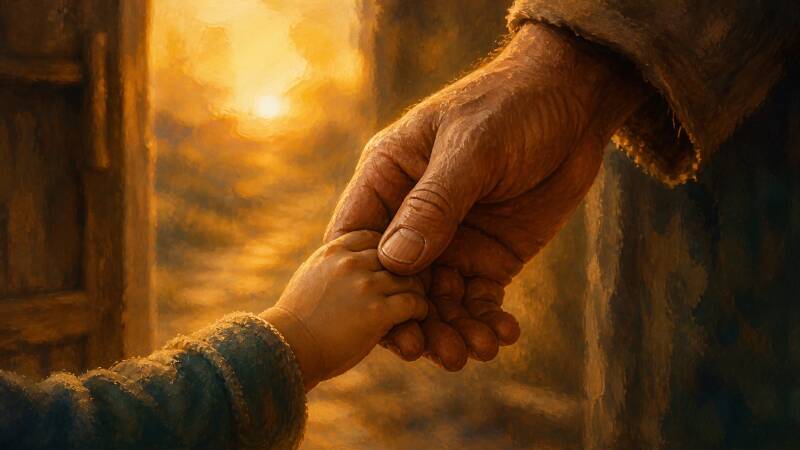
Among all the staggering claims the Bible makes, this one is hard to top: that sinful human beings can be brought into the family of God and called his sons. Sinclair Ferguson calls our adoption as God's children "the apex of creation and the goal of redemption" — the very purpose of our existence. The universe is not a stage for our private dramas. It exists, in part, so that you could be called a child of God.
Most Christians do not think about themselves this way. Yet Romans 8:14-17 unfolds five things that characterise everyone who belongs to Christ: status, holiness, security, assurance, and hope. Each of them turns on the same astonishing fact — that the Spirit of God has made us sons.
Status — out of the courtroom, into the living room
Justification is the Christian's first privilege. It is the door through which we enter the Christian life. In the great courtroom of God, the verdict comes back: not guilty — not because we are innocent, but because Jesus has lived and died in our place. Romans 3:21-26 sets out that towering achievement.
But adoption is not the door. Adoption is the destination. After acquittal in the courtroom, God does not let us walk out into the street. He brings us through into his living room and sits us down at the family table. "How great is the love the Father has lavished on us, that we should be called children of God! And that is what we are." If you are a Christian today, you have been adopted.
Paul, a Roman citizen writing to Romans, is drawing on the legal practice his readers knew. In the Roman world, a wealthy man without an heir would adopt a son to inherit his estate. The moment the adoption was finalised, four things happened. The man's old debts were cancelled. He took his new father's name. He became the legal heir of everything his father owned. And he took on the obligation to honour his new father.
All four of those things have happened to the Christian. You have not been adopted by Bill Gates or Elon Musk — which, on reflection, is probably a mercy. You have been adopted by God himself. He treats you as he treats his own Son, Jesus Christ. As verse 17 will say, you are a co-heir with Christ.
Sons — including daughters
Many translations soften verse 14 to read "children of God." Paul does not. He uses a word that means sons. This is not casual or careless language; it is theologically pointed. In the Roman world, only men were adopted, and only sons inherited. By calling Christian women sons of God, Paul is making a radical claim: in Christ, the privileges and inheritance once reserved to men belong to women too. Equal status, equal rights, equal inheritance. Just as elsewhere he calls Christian men part of the bride of Christ, here he gives the language of sonship to all believers. It is not about gender. It is about standing.
Holiness — the motive of a son
Verse 14 begins with a small word that carries great freight: because. It connects what Paul has just said about putting sin to death (v.13) with what he is now saying about being sons of God. Why fight sin? Why endure the daily ache of resisting temptation, of cutting off the right hand, of gouging out the right eye?
Not because we are stoics with a cold philosophy of self-mastery. Not because we are masochists in love with the pain of self-denial. Not because we are self-righteous kill-joys who hate to see other people enjoy themselves. The Pharisees obeyed for credit, hoping to build up an account in God's books. Their rules and rituals piled up like coins in a religious purse. But Jesus pointed past this performance-driven religion to a different motive entirely: "Be perfect, therefore, as your heavenly Father is perfect."
That is the motive of a son. We fight sin because God is our Father, and we love him, and we want to please him, and we want to be like him. We do not pursue holiness to become sons. We pursue it because we already are.
Security — slaves of fear or sons in love
Verse 15 explains adoption by contrasting it with its opposite. "You did not receive a spirit that makes you a slave again to fear, but you received the Spirit of adoption." There are two ways to live the Christian life, and many Christians spend years confusing one for the other.
One way is the way of the slave. A slave in the Roman world was utterly at the mercy of his master. He could be beaten, sold, even crucified — and there was no court of appeal. Imagine living each day in that atmosphere: the dread always hanging over you, the inability to relax, the gnawing fear that one wrong step might ruin everything. Some Christians live exactly that way. If I miss my quiet time today, God will be angry with me. If I do not witness to three people this week, God will withdraw his love. If I trip into the same sin again, I might forfeit my place in the family.
That is not what God has given you. He has given you the Spirit of adoption. He relates to you not as a hard taskmaster looking for an excuse to dismiss you, but as a loving, patient, gracious, kind, merciful, good Father. A son and a slave might do exactly the same things — both might weed the same garden — but they do them in completely different atmospheres. The son does not weed in terror that pulling up the wrong plant will get him thrown out of the family. He weeds knowing that he is loved, that his father's love is unconditional, that his place in the home does not hang on his performance.
This does not mean that anything goes. The standard remains very high — those who are led by the Spirit put to death the misdeeds of the body. But the air we breathe while we obey is utterly different. We obey freely, joyfully, without the suffocating fear of being abandoned. And when we sin, we go to our Father, ask his forgiveness, and find that his arms are already open.
Assurance — Abba, Father
How do we know we are sons? Verses 15 and 16 give the answer in some of the most tender language in the New Testament. "By him we cry, 'Abba, Father.' The Spirit himself testifies with our spirit that we are God's children."
The verb translated "cry" is not a polite call. It is the cry of need — the instinctive shout of a child who has fallen, who is afraid, who is hurt. No parent has to teach a small child to cry out for them when they are scared. There is no rehearsal, no training course, no script. The cry comes out automatically. Daddy. Mummy.
This, Paul says, is what the Spirit works in the Christian. When we are afraid, when we are in danger, when we have just sinned for the hundredth time and feel disqualified from drawing near, our instinctive reaction is to cry out: Abba, Father. Not "God." Not "Lord of hosts." Not even, in the first instance, "heavenly Father." Abba. The intimate word a child uses for the parent who tucks them in at night. Martyn Lloyd-Jones called it "a word lisped by a little child." It is the word Jesus himself used for God in every recorded prayer except his cry of dereliction on the cross.
Imagine the heart as a courtroom. The prosecution — the devil and your own sinful nature — lays out a case that you are no son of God. Look at what you just did. Look at what you have not done. A real Christian would not think this. A real Christian would not say that. The accusations are loud and persistent. And then the Spirit of God himself takes the witness stand and testifies: I know this person. He is a child of God. She belongs to the Father. I have seen what no one else can see. The verdict in the courtroom of your own heart is settled — not by your evidence, but by his.
Hope — heirs of God
And there is more to come. "Now if we are children, then we are heirs — heirs of God and co-heirs with Christ."
Inheritances in this world are usually divided. The estate is parcelled out, lawyers take their fee, distant cousins receive a token slice, and most of us end up with rather less than we hoped for. The kingdom of God is nothing like that. Every son receives the full inheritance. The estate is not diminished by being shared.
And what is the inheritance? It seems, finally, to be God himself. The psalmist understood this long before Paul wrote: "Whom have I in heaven but you? And earth has nothing I desire besides you. My flesh and my heart may fail, but God is the strength of my heart and my portion forever" (Psalm 73). The inheritance of the Christian is not a thing God gives. It is the God who gives himself.
This is why verse 17 can speak so calmly about sharing in Christ's sufferings. The cost of being in this family is real. To follow Jesus is to walk where he walked, including some of the harder places. But the inheritance at the end of the road is not a token sum after the lawyers have finished. It is everything. And every child of God receives all of it.
Your birthright
Status. Holiness. Security. Assurance. Hope. If you are a Christian today, that is your birthright. Not your achievement — your inheritance. Not what you climbed up to earn, but what was lavished on you when you were brought into the family.
And if you are not yet a Christian, this same passage holds out an invitation. God is still adopting new members into his family. The door is still open. He calls weary, fearful, debt-ridden people in from the courtroom, cancels the case against them in the blood of his own Son, and brings them home to a Father who runs to meet them.
This is what Romans 8 calls life in the Spirit. It is what the previous chapter could only long for. It is what every other religion in the world tries, and fails, to give. It is yours, freely, in Christ.
Add comment
Comments