

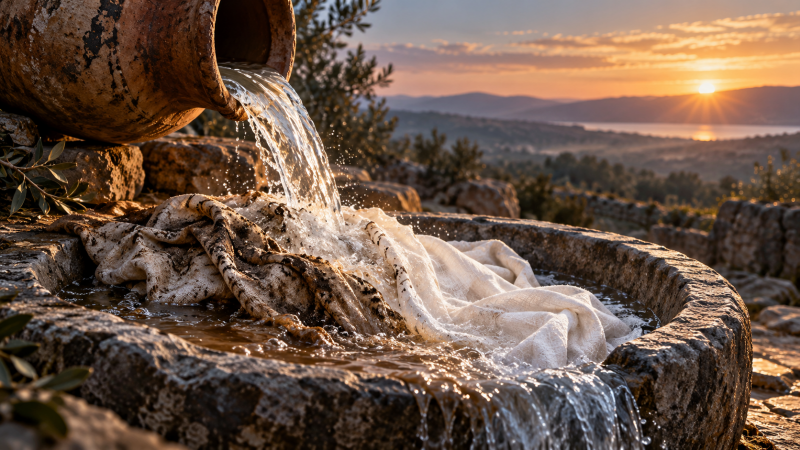
A white rose may suggest innocence. Water tells a different story.
At a baptism, the water is a sign of washing. That simple fact carries an uncomfortable message: we need to be cleansed. We may look respectable to others. We may even think well of ourselves. Yet God sees beneath the surface, and Titus 3:3 gives a searching description of the human heart:
“At one time we too were foolish, disobedient, deceived and enslaved by all kinds of passions and pleasures. We lived in malice and envy, being hated and hating one another.”
This is not a portrait of a particularly disreputable minority. Paul includes himself: “we too.” He had been disciplined, religious and outwardly blameless. Still, when he looked back on life apart from Christ, this was his verdict. Titus 3 does not flatter us. It tells us why salvation must begin with God.
Foolish about what matters most
In the Bible, foolishness is not a lack of intelligence. A person can be clever, educated and successful while living as though God does not matter. Scripture says, “The fear of the Lord is the beginning of wisdom” (Proverbs 9:10). To leave God out of our decisions, desires and worship is therefore the deepest folly.
God is our Creator, King and Judge. Nothing is more sensible than listening to him, trusting him and ordering our lives by his Word. Yet by nature we do the opposite. We can understand difficult ideas and still find the things of God dull or baffling. What moves a believer to gratitude may leave another person untouched. The problem is not merely a shortage of information. We need new hearts.
Disobedient in thought, word and deed
God has not hidden what he requires. We are to love him with all our heart, soul, mind and strength, and to love our neighbour as ourselves. His commandments reach into our use of time, money, bodies, speech and abilities. They address what we do and what we leave undone.
Our answer has repeatedly been no. We have put ourselves first, misused good gifts, nursed anger, coveted what belongs to others and withheld the love we owed them. Even our best days fall far short of wholehearted love for God. Sin is not an occasional stain on an otherwise spotless life. It is resistance to the rightful rule of God.
Deceived by sin
Sin lies to us. It persuades us that rebellion against God is a small matter, that we are basically good, and that a little self-improvement will put everything right. It also distorts what we think a good life consists of. Education, work, money, family, friendship and health are genuine gifts, but none can bear the weight of being our greatest good.
We are deceived about God too. Some imagine that he is too indulgent to judge sin. Others picture him as cruel and eager to condemn. Still others live as though he were distant and uninterested. None of these inventions is the living God revealed in Scripture: perfectly holy, unwaveringly just, abundant in mercy and intimately involved with his creation.
Enslaved by our desires
Titus 3:3 goes further. We are not simply people who make some poor choices. We are “enslaved by all kinds of passions and pleasures.” A passion in this sense is something we feel we must have if life is to be worth living. It might be career success, family approval, academic achievement, sexual pleasure, physical health or financial security. The thing itself may be good. The slavery begins when it takes the place that belongs to God.
An idol promises identity, safety or satisfaction, then rules the person who trusted it. We may tell ourselves that we could loosen our grip whenever we wished, but the prospect of losing it fills us with panic. Our hearts have become captive to a created thing.
The old account of Reynald III makes the point vividly. Imprisoned by his brother, the fourteenth-century duke was kept in a room with a doorway through which he could have escaped if he lost enough weight. Lavish meals arrived each day, and he remained there for years. His appetite became his jailer. Our prisons may look more respectable, but we are no better able to free ourselves from ruling desires.
Malice, envy and hatred
When people compete to secure life from things that cannot give it, relationships sour. Malice wishes harm on another person; envy resents the good they receive. We recognise both in the secret satisfaction we may feel when someone admired is embarrassed or brought down. Another person's promotion, praise or happiness can feel like a verdict against us.
Hatred thrives wherever sinners defend their pride. The speed with which ordinary disagreement becomes contempt, especially when people feel anonymous, exposes what is already in the heart. Paul is not claiming that every person behaves as badly as possible. Human beings still do many outwardly admirable things. He is describing the poisoned root from which our sins grow.
This is why the gospel cannot begin with advice about becoming nicer. We do not merely need better habits. We need to be rescued, washed and made new.
Righteous deeds cannot wash us
The turning point comes in Titus 3:5: “He saved us, not because of righteous things we had done, but because of his mercy.”
No number of religious or charitable acts can erase guilt before God. Bible reading, prayer, church attendance and service to others are good, but they cannot purchase a clean record. A person convicted of a terrible crime could not cancel the offence by offering to collect litter or work for a charity. The proposed deeds might benefit others, yet they would not answer the charge. In the same way, our later obedience cannot undo our rebellion against God.
That is why the Christian gospel is good news rather than a self-improvement programme. God does what we cannot do. He saves. The same grace is unfolded in A righteousness from God (Romans 3:21–26): sinners are declared righteous through the redemption accomplished by Jesus Christ, not through a record of their own making.
The washing God provides
Baptism pictures both our need and God's provision. The outward water does not itself cleanse the heart. It points to the reality promised in Titus 3:5: “the washing of rebirth and renewal by the Holy Spirit.” God does not apply a little polish to the old life. By his Spirit he gives new birth.
At the centre of this washing is Christ's work in our place. Our guilt was laid upon him at the cross, and his perfect righteousness is counted as ours. The article It is finished (John 19:30) explores the completeness of that payment. Nothing remains for us to add. Those who trust Christ are clean in God's sight because Christ has borne their uncleanness and given them his obedience.
The Spirit also begins an inward renewal. He changes what we love and how we think. Old masters lose their unquestioned authority. A Christian still battles sin, sometimes painfully, but no longer belongs to it. Work, family, achievement and health can be received as gifts rather than worshipped as gods. This is the new birth Christ described to Nicodemus, considered more fully in You Must Be Born Again (John 3:1–21).
The sign must lead us to Christ
A baptism is a visible promise of cleansing, but possessing the sign is not the same as possessing the reality. A person may have received water in infancy or adulthood and still remain apart from Christ. The question is not merely, “Have I been baptised?” but, “Have I come to Christ for mercy? Has the Holy Spirit given me new life?”
Titus 3 leaves no room for pretending that we are already clean enough. It also leaves no room for despair. No past is too stained for the blood of Christ. No slavery is too strong for the renewing power of the Spirit. The foolish, disobedient, deceived and hateful are precisely the people God saves.
One day Christ will remove all uncleanness from his renewed creation. Revelation 21:27 says that nothing unclean will enter the heavenly city. That warning makes the matter urgent, but the water of baptism directs us to a gracious answer. We cannot wash ourselves. God, in mercy, washes all who come to Jesus Christ.
Add comment
Comments