

It is a strange little episode, tucked into the middle of John’s Gospel and easy to read past. A handful of Greeks arrive in Jerusalem for the Passover, ask quietly for Philip, and make a single request: “Sir, we would like to see Jesus” (John 12:21). Jesus does not even meet them. The Greeks disappear from the narrative as suddenly as they arrived. And yet John records this moment with deliberate care, because what looks like a footnote turns out to be a hinge on which the whole story of redemption swings.
A Request That Changed Everything
John’s Gospel falls into two unequal halves. The first eleven chapters cover three years of public ministry — the so-called “book of signs”, in which Jesus reveals himself to the world through seven miracles. The remaining chapters cover just one single week, and they read like a different kind of book altogether: the “book of glory”, in which Jesus reveals himself privately to his disciples. Chapter 12 is the seam between the two.
And the trigger, the moment everything turns, is this request from the Gentiles.
Up to this point in his ministry, Jesus has had almost no contact with non-Jews. He told the Canaanite woman openly that he had been sent only to the lost sheep of the house of Israel. Yet here, at Passover, a small group of God-fearing Greeks — Gentiles who had attached themselves to the faith of Israel but were still excluded from the inner courts of the temple — ask to meet him. They cannot cross the warning stones into the Court of Israel; trespass is punishable by death. So they approach Philip, perhaps because his name is Greek and his hometown borders Gentile territory, and they ask if Jesus might come out to them.
The Pharisees, in the previous verse, have just lamented in frustration: “Look how the whole world has gone after him.” They meant it sarcastically. They did not realise they were prophesying. John means us to see these Greeks as the first fruits of a global harvest — the spiritual ancestors of every Gentile who, in the centuries that followed, would come from every nation under heaven asking the same question. We would like to see Jesus.
You and I are in that harvest. Christianity is not just for Israel. It is for Ireland as much as for Israel. The whole world has gone after him — and we are part of the answer to the Pharisees’ bitter complaint.
The Cry of Every Hungry Heart
It is worth pausing to ask whether this request is the longing of our hearts today. We would like to see Jesus.
That is the perfect prayer for every disciple, and especially for every gathering of the Lord’s people on the Lord’s day. It is the prayer to bring to the Lord’s table when bread is broken and wine is poured. It is the prayer of the soul that has tasted enough of itself to know it needs something more.
The Puritan commentator Matthew Henry put it well: in our worship, the great desire of our souls should be to see Jesus — to have our acquaintance with him increased, our dependence on him deepened, our conformity to him advanced. We miss the whole point of coming if we do not see Jesus.
How often have we sat through a service of worship as if our eyes were closed the whole time? Singing songs we do not feel, hearing words we do not hear, leaving as cold as we came — not because Christ was absent, but because we were not looking. The Greeks travelled hundreds of miles and risked their lives to ask after him. We can scarcely lift our heads.
This is the question Holy Communion always puts to us. It is the question every Lord’s day puts to us. It is, in the end, the question every Lord’s Supper hangs upon. Are we coming to see Jesus?
The Hour Has Come
Jesus’ reply to the Greeks’ request is not what we would expect. He does not say, “Send them in.” He does not even acknowledge them by name. Instead he says, “The hour has come for the Son of Man to be glorified” (v.23).
Throughout John’s Gospel up to this point, Jesus has spoken of an “hour” that had not yet come. It hovered in the background — mentioned at Cana, hinted at in the temple, spoken of in private conversation. But from this verse onwards, everything changes. The hour has now come. It is mentioned again at the start of chapter 13, and again in his great prayer of chapter 17. The clock has started.
What hour is this? In John’s vocabulary it is the hour of the cross. The hour of glory. The two are the same thing, because in John’s Gospel the cross is not the prelude to glory — it is the glory. The hour has come for the Son of Man to be glorified, and the throne on which he will be glorified is a wooden one.
Why does the arrival of a few Gentile inquirers trigger this announcement? Because their request is itself a sign. The world is beginning to ask after the Messiah. The walls between Jew and Gentile are beginning to crack. But none of it can happen — not the worldwide harvest, not the gathering of every tribe and tongue, not the entrance of you and me into the family of God — until the seed has fallen into the earth and died.
The Grain That Must Die
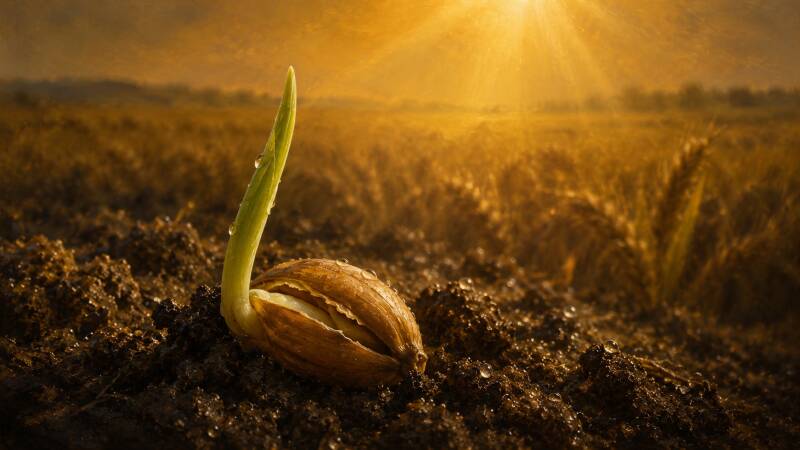
Jesus explains the necessity with one of the most beautiful images in the Gospels: “Unless a grain of wheat falls to the ground and dies, it remains only a single seed. But if it dies, it produces many seeds” (v.24).
Every farmer who has ever planted understands this. A seed left on the shelf stays one seed. A seed in the ground rots and disappears — and from that disappearance comes a harvest a hundred times its size. Multiplication requires burial. New life requires the death of the old.
This, says Jesus, is what is about to happen to him. I am the seed. The reason the Greeks can ever truly see Jesus — the reason any of us can — is because the seed had to die. The Son had to be forsaken by his Father on the cross. Darkness had to fall over the land. The body had to be laid in a borrowed tomb. Only then could the harvest break out of the ground on Easter morning and begin its march across the centuries.
If you have ever wondered why the gospel must include the cross — why we cannot have a Jesus of love without a Jesus of blood — the parable of the seed answers it. There is no harvest without burial.
Walking the Same Road
And then Jesus does something startling. He takes the principle that explains his own death and applies it to ours. “The man who loves his life will lose it, while the man who hates his life in this world will keep it for eternal life. Whoever serves me must follow me, and where I am, my servant also will be” (vv.25–26).
The seed that dies and multiplies is not just a picture of Christ. It is a pattern for every disciple. The Master is buried, and so are his servants. The Master loses his life to find it, and so do they. To follow Christ is to bury your old loves — love of self, love of comfort, love of money, love of the praise of others — and to wait, in the dark soil of obedience, for a harvest you cannot yet see.
Christianity is not just the announcement that Jesus died for your sin. That is the foundation. But on that foundation is built a life in which you, every day, die to your sin. You are not saved by it. You will never atone for anything by it. But the unmistakable mark of a Christian is a slow, daily dying — and a slow, daily resurrection into the life of Christ.
It is the road every saint has walked. It is the road the Greeks at the Passover would learn to walk, if they ever became disciples. It is the road that runs from the cross to the empty tomb, and on through history, and into the new creation.
And it begins exactly where the Greeks began, with a hunger so deep that it cannot be put off any longer: “Sir, we would like to see Jesus.”
Add comment
Comments