

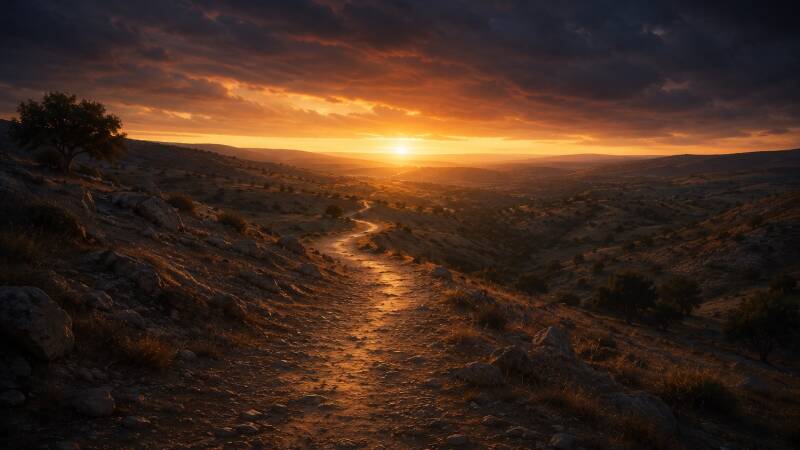
Picture a traveller on a road in the Palestinian countryside two thousand years ago. The day is closing, the light is dimming, and there are no street lamps, no torches, no glow from a nearby town — and in the Middle East darkness falls fast. The advice is obvious and urgent: keep moving while you still can. Cover as much ground as possible before the light disappears, because once it is gone you will not be able to see your hand in front of your face. You will lose the path. You may walk straight off a cliff.
That is the picture behind one of the most pressing things Jesus ever said: “Walk while you have the light” (John 12:35). Stripped to a sentence, his point is simply this: make the most of the opportunity in front of you, because it will not last.
“You are going to have the light just a little while longer. Walk while you have the light, before darkness overtakes you… Put your trust in the light while you have it, so that you may become children of light.” (John 12:35–36)
The light, of course, is Jesus himself. From its opening chapter, John’s Gospel has called him “the true light that gives light to everyone” (John 1:9). And the light was about to be put out at the cross. So the warning lands with real weight: the time to trust him is now.
The shrinking window
For anyone who has not yet trusted Christ, this is the heart of the matter. The opportunity to believe is real, but it is not unlimited. There are flickers of interest — a sermon that lands, a conversation over coffee, a quiet inner voice saying this is true, I really should respond. That prompting is the Spirit of God shining light into a darkened heart. But the warning of Scripture is sobering: that light will not shine forever.
There are at least three kinds of darkness that can close in.
The darkness of a hardened heart. A person can reject the light so often that, in the end, God confirms them in their choice. The conscience that was once tender sets like concrete, and the flicker of interest never returns. This is especially solemn for those who hear the gospel year after year and keep saying no. Who knows when the last prompting will come?
The darkness of death. None of us knows when our death will come, or how. Many put off any decision about Christ because they assume there is plenty of time — they imagine a quiet deathbed where everything can be sorted out at the end. But there may be no deathbed. Death can arrive suddenly. And even where it comes slowly, the mind itself may dim — through pain, medication, or confusion — until clear thought is gone. The light of reason is guaranteed to no one.
The darkness of judgment. Beyond death lies what Jesus elsewhere calls “outer darkness,” where no ray of grace ever reaches. Once we pass from this world, the opportunity to repent is over; there is no second chance. (If that troubles you, it is worth wrestling honestly with the question, how can a God of love send anyone to hell?)
Becoming children of light
But the warning comes wrapped in a wonderful offer. Trust the light, Jesus says, “so that you may become children of light.” That is a staggering thing to hold out to someone sitting in darkness: not a passing interest in the light, but a whole new identity defined by it.
It is the same gift described elsewhere as being born again, and as being adopted as sons and daughters of God. A child of light is someone whose defining characteristic is no longer darkness but light — purified, transformed, reflecting the very character of the Lord. We stop being children of darkness and become children of light, and it happens the moment we put our trust in him.
Keep walking
There is a second audience here too. The words are aimed mainly at those still outside, but they carry a vital lesson for everyone already inside. Literally, Jesus says, keep on walking while you have the light. This is not a once-for-all act at the start of the Christian life; it is the shape of the whole journey.
Think of someone delivered from addiction. His old life was a wretched darkness — ruined health, squandered money, broken relationships. Now he is clean, and life is as different as night and day, incomparably better. And yet the pull of the old way never quite disappears. He has to keep choosing, daily, the life he has been given over the life he has left.
The Christian life is a little like that. We are all, in a sense, recovering addicts to sin. We have come out of the darkness into the light — and we still feel the tug of the dark. So every day, every hour, we keep on choosing to walk in the light rather than slip back.
Making the most of the light
What does that look like in practice? Three habits stand out, each one a way of seizing an opportunity that this life alone affords.
- Worship and fellowship. “Be very careful, then, how you live… making the most of every opportunity, because the days are evil” (Ephesians 5:15–16). Many believers around the world meet in secret, in tiny groups, at risk of prison or worse. By comparison we are rich — free to gather often, with the Scriptures open and brothers and sisters beside us. The question is whether we are using even a fraction of what we have been given.
- Doing good. “As we have opportunity, let us do good to all people, especially to those who belong to the family of believers” (Galatians 6:10). In the world to come there will be no lonely people to visit, no sick to pray for, no needs to meet. This life is the only window we have to love one another in these costly, practical ways.
- Sharing the gospel. “Always be prepared to give an answer to everyone who asks you to give the reason for the hope that you have” (1 Peter 3:15). There will be no evangelism in the new heavens and the new earth. While the light of God’s grace still shines, this is our one chance to carry it to people in the dark.
The nineteenth-century pastor J. C. Ryle pressed the point as sharply as anyone: “The throne of grace will not always be standing,” he warned. Our time for doing good “is short and limited; let us take heed that we make good use of it. Have we Bibles? Let us read them. Have we Sabbaths? Let us not waste them.”
We have each been given a different measure of light — and to whom much is given, much is required (Luke 12:48). The question is not whether you have as much as someone else, but whether you are walking in the light you have. The window is open now. The opportunity is in your hands today. So while it is still day, before the dark presses in: walk while you have the light.
Add comment
Comments