

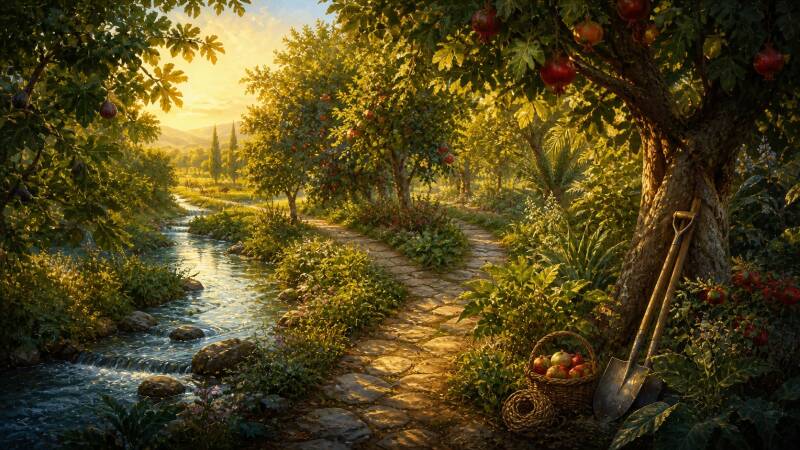
Try this thought experiment. You are standing in a place so beautiful, so abundant, so alive that the senses cannot quite take it in — the colour of the leaves, the scent of the blossoms, the sound of cold clean water moving through the garden, fruit of every kind hanging within easy reach. The light is perfect. The air is perfect. The animals are quiet. And then a voice calls your name, and you know — with no anxiety, no embarrassment, no hiding — that the One who designed this whole place is walking with you. That, in Genesis 2:4–17, is the world you were originally made for.
Genesis 2 is sometimes read as if it were a second, slightly confused creation story bolted on next to Genesis 1. It isn't. Read closely, the verse that opens the section — "This is the account of the heavens and the earth when they were created" — is the first of ten such headings that structure the whole book of Genesis. Translated more literally, it reads, "These are the generations of…" — meaning, this is what came forth from. Genesis 1 is the prologue, the story of the heavens and earth being made. From here on, the focus shifts: what did those heavens and earth produce? Moses, the author, was no muddled compiler. He was, as Acts 7 reminds us, trained in all the wisdom of the Egyptians. He knew exactly what he was doing.
And the section he opens here — running from chapter 2:4 right through to chapter 4:26 — is bookended by two extremes hard to imagine alongside one another. It opens with a man and his maker in perfect harmony in a garden of God's own design. It closes with an arrogant polygamist boasting to his multiple wives of having murdered a young man over a trivial injury. The whole section is the long, painful answer to one question: How did we get from there to there?
This particular passage is the calm before the storm. The scene is set. The cast is introduced. And before the catastrophe of chapter 3, we are given a single, precious snapshot of what life was like before the Fall — and, by the grace of God, of what life will be like again, in fuller form, when all things are made new.
Two things stand out about that snapshot: Eden was a place of worship, and Eden was a place of work.
A place of worship
Verse 7 expands on the account of humanity's creation given in chapter 1. It does not contradict it; it deepens it. "The Lord God formed the man from the dust of the ground and breathed into his nostrils the breath of life, and the man became a living being."
Two verbs do a great deal of work in that single sentence. The first, formed, is the verb used elsewhere in the Old Testament of a potter at his wheel, a carpenter at his bench, a sculptor at his stone. It is the word for a craftsman shaping raw material into something beautiful. Here is the supreme Artist, kneeling down — to speak in human terms — and gathering up the dust of the earth between his fingers, fashioning it carefully, deliberately, into the shape of a man. This is not how anything else in creation was made. The rest of the cosmos was spoken into being: "And God said… and it was so." Humanity is different. Humanity is hand-made.
The second verb is even more startling. God did not simply assemble Adam and walk away. He breathed into him. The picture is one of face-to-face intimacy, of the kiss of life — the Creator pressing close enough to share his own breath with this creature of dust. From the very first moment of his existence, Adam enjoys a closeness with God that is offered to no other creature anywhere in the universe. This is what it means to be made in the image and likeness of God. Human beings are made for God in a way that nothing else in creation is.
And then this hand-made, breath-filled creature is given a hand-made, breath-filled place. The Garden of Eden is not a survival camp. It is not a meagre patch of dust. God has just declared all the planet very good in chapter 1:31; but Eden is more than very good. Eden is excellent within the excellent. The 18th-century landscape designer Lancelot "Capability" Brown was famous for surveying a great estate and seeing all its hidden capabilities; in his lifetime he designed more than 240 gardens, including Blenheim Palace and Chatsworth. Imagine instead a garden designed personally by God. Trees beautiful to look at and good for food. Rivers of cold, clean water flowing out into four great waterways. Fragrance, colour, abundance. The Greek translators of this chapter reached for the word that comes into English as paradise.
But the best thing about Eden was not its fruit or its rivers. The best thing about Eden was that the Lord God walked there. Adam met his Maker face to face, and Eden was a kind of garden-temple — the place where God came down and was worshipped by the man he had formed. There is a quiet hint of this in verse 15, where Adam is told to work and to keep the garden. Those two Hebrew verbs, in pairing, occur elsewhere only of the priests and Levites serving in the Tabernacle. Adam is being commissioned as a priest of a garden sanctuary. The later Tabernacle and Temple are not the original; Eden is the original, and they are the careful copies.
What all this says — gently but unmistakably — is that human beings are made for worship. Not first for productivity, or family, or success, or comfort. For worship. The deepest happiness available to a human being is happiness in a right relationship with the One who breathed life into our nostrils. Take the family, the marriage, the children, the work, the friendships, the hobbies — all gifts, all genuinely from God's hand, all meant to be enjoyed — and stack them up beside that primal relationship, and not one of them, nor all of them together, can bear the weight of being the meaning of your life. They were never made to bear it. Worship is what we were made for.
A simple, searching question follows. Is worship what your life actually revolves around? Daily personal worship; family worship if you are in a family; and above all, gathered worship of God on the Lord's Day with his people. If not, what has been promoted into worship's place?
A place of work
The second feature of Eden is just as important, and surprises modern readers as much as the first one used to. Eden was not a holiday camp. Eden was a working garden.
"The Lord God took the man and put him in the garden of Eden to work it and take care of it." Before there is any hint of the Fall, before sin enters the world, before there is any curse on the ground, God gives Adam a job. There is a garden to keep. There are trees to be tended. Animals will be brought to him to be named. Most importantly of all, the sanctuary will need to be guarded — a charge Adam will tragically fail at in chapter 3, when the serpent walks freely in to ask his deadly question.
This single verse rewires the entire theology of work. Work is not a punishment for sin. Work is not the curse of the Fall. Work was here in Eden, before there were any thorns to fight or any thistles to pull. Work is part of the original job description of being human — a continuation of the great commission given in Genesis 1:26–28 to fill the earth and rule it as God's stewards. To work is to image God, who is the original worker. To work conscientiously, gladly, and well is part of how we worship.
That is why unemployment and redundancy strike so deep at the human spirit. We are not made simply to consume; we are made to make, to till, to keep, to build, to mend. We are made to have something to do that matters and to do it well.
It is also worth noticing what kind of work Adam was given. Much of it was manual labour — the kind of work modern Western societies have increasingly come to look down on. We live in an age that prizes degrees and professional careers and quietly treats trades and physical work as second-class options. The shortage of skilled hands in every sector tells the bill of that prejudice. But Genesis 2:15 will not let that prejudice stand. Adam was a gardener. Jesus, for the great majority of his adult life — before three short years of public ministry — was a carpenter. There is nothing demeaning about manual work; there is dignity in it because God ordained it and the Son of God himself practised it.
Whatever your occupation, paid or unpaid — office, factory, classroom, laboratory, building site, kitchen, hospital ward, school run, allotment — verse 15 can be read with your own name in it: "The Lord God took ___ and put them in ___ to work it and take care of it." Your job, whatever it is, is part of your sacred calling as a worshipper.
Two opposite traps
If work is part of worship, then work must always serve worship — never replace it. There are two opposite ways to go wrong here, and the enemy of our souls is happy with either one.
The first is to make an idol of work. To pour everything into the career, the project, the business, the next promotion — to draw all meaning, identity, and significance from what we produce, until the day a doctor or a redundancy notice or a quiet exhaustion shows us how flimsy that scaffolding was. The second is to be idle in work — to drift through tasks half-heartedly, treating work as a necessary evil rather than a gift, doing the minimum, despising the very thing God gave to dignify us.
The fourth commandment guards us at both ends of this spectrum. "Six days you shall labour and do all your work." That is a command, not just a permission — most of our time is given over to whatever work God has set in front of us. "But the seventh day is a Sabbath… on it you shall not do any work." And that is a command too — a weekly reminder, written into the rhythm of creation, that our greatest purpose is not what we produce but Whom we worship. The first sermon in this Eden series picked up exactly that thread; if Sabbath is the structuring rhythm, see 8. The First Sabbath (Gen 2.1-3) for the longer treatment.
Where Eden went, and where it returns
The Garden of Eden holds a strange fascination over the human imagination. Scholars have spilled rivers of ink trying to locate it. The geographical detail in verses 10 to 14 is precise: four rivers branching from one, with named territories — somewhere, most probably, around the Persian Gulf. But after thousands of years of curse, and after the catastrophic upheaval of the flood in Genesis 7, it is more than likely that a person could stand directly on the spot today and not know it. The Eden of Genesis 2 is gone for good in this present world.
And yet Eden is not gone in the deeper sense. It is the template — the picture God has given us of what human life was meant to be: made for worship, made for productive work in service of God, made for unbroken fellowship with our Creator. Every time we worship sincerely, every time we work as unto the Lord, every time we tend something well and guard it faithfully, there is a small, partial recovery of Eden happening in our homes and societies. It is faint, and it is shadowed by the Fall — exactly the groaning that Paul describes in Romans 8:18–25, where the whole creation strains forward in childbirth, longing for the restoration of all things. But the longing is itself a gift, because it points beyond itself.
What it points to is a paradise yet to come, even better than the one in Genesis 2. Jesus said it as he hung dying for the sins of those who would put their trust in him: "Today you will be with me in paradise." The garden lost in Genesis 2 reappears in Revelation 22, restored and amplified, with the tree of life bearing its fruit every month and the river of the water of life flowing from the throne of God. And on that day, those who belong to Christ will find that everything in this first paradise — the worship, the work, the walking with God in the cool of the day — was only a foretaste of a country deeper, fuller, and more permanent than this one ever was.
If you are not yet a Christian, this is the offer: through faith in Jesus Christ, the door of that eternal Eden stands open. Refusing it is to insist on staying outside the garden forever. Stepping through it is to begin, even now, to live as the worshipper-worker you were made to be — and to know that the best of Eden is not behind you but in front of you.
"The Lord God took the man and put him in the garden of Eden to work it and take care of it." — Genesis 2:15
Add comment
Comments