

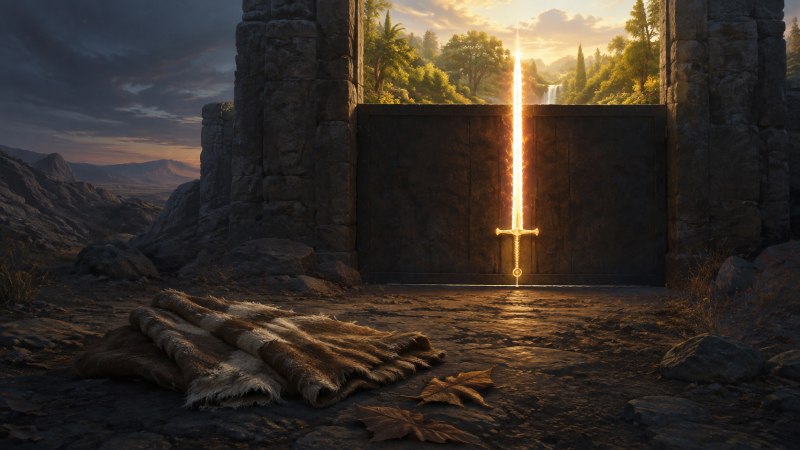
The closing verses of Genesis 3 appear to be filled with loss. Adam and Eve are clothed in animal skins, barred from the tree of life, driven from Eden, and kept out by cherubim and a flaming sword. Paradise is behind them, and the ground ahead is cursed.
Yet grace is present in every part of the scene. God does not pretend that sin is harmless, but neither does he abandon the guilty. He provides a covering they could never make, closes the door to a terrible kind of immortality, gives them a world where life can continue, and guards the hope of a future return.
A name filled with faith
After hearing God's sentence, Adam names his wife Eve, a name connected with life, "because she would become the mother of all the living" (Genesis 3:20). It is a surprising choice. Death has entered the world through their rebellion. Adam himself will return to the dust. He might have chosen a name shaped by loss or blame.
Instead, he names her Life. His choice rests on God's promise that the offspring of the woman will crush the serpent (Genesis 3:15). Adam believes there will be children, a future, and ultimately a deliverer. The first response to God's first gospel promise is faith.
Faith does not remove the earthly consequences of sin. Adam and Eve must still leave Eden. The ground will still resist Adam's work, and death will eventually take them. But God's promise changes how they walk into that hard future. They go out under judgement, yet they go out believing that life will come through the woman's offspring.
The covering God provides
Adam and Eve had already tried to cover themselves. Their fig leaves concealed part of their nakedness, but their real problem ran much deeper. Nakedness had become a sign of guilt and shame before God, and no hurried piece of sewing could put that right.
God made garments of skin and clothed them (Genesis 3:21). For the first time, an innocent creature appears to die so that guilty people can be covered. Genesis does not tell us what animal was killed or describe a formal sacrifice, but the scene establishes a pattern that runs through the Bible: sin brings death, and sinners need a covering that God himself provides.
The sacrifices of the Old Testament made that lesson visible. Blood stained the altar and sanctuary because, as Hebrews 9:22 explains, "without the shedding of blood there is no forgiveness." Yet the blood of animals could never finally remove human guilt. Those sacrifices pointed ahead to the Lamb of God.
Our own fig leaves take many forms. Some people trust religious activity, respectable behaviour, generosity, or private attempts at self-punishment. These things may alter appearances, but they cannot answer God's judgement. Only Jesus can cover guilt. He lived the obedient life we have not lived and died the death our sin deserves.
A searching question exposes where our confidence lies: if God asked why he should receive us into heaven, what would we say? Any answer centred on our decency, effort, or religious record is still made of fig leaves. The Christian's hope is Christ alone: his righteousness, his death, and his mercy.
Mercy in the closed gate
God then prevents Adam and Eve from taking fruit from the tree of life and living for ever (Genesis 3:22). This is a penalty, but it is also mercy. Endless life in a fallen body, with a sinful heart, in a world of violence and grief would not be salvation. It would be an endless prison.
Human beings still dream of escaping death while leaving the deeper problem untouched. We spend vast sums trying to delay ageing, extend life, or preserve the body for some future cure. A few more years may be welcome, but everlasting life as we are now would only prolong what is broken.
God has something better than immortality in sin. The gospel offers resurrection life in a renewed creation, where righteousness, joy, and peace are at home. The way to that life is not found by slipping back into Eden. It comes through Jesus Christ.
Outside Eden, but not without kindness
God banished Adam and Eve from the garden to work the ground from which Adam had been taken (Genesis 3:23). They lost the garden sanctuary where God had walked with them. Life in Eden, with its unbroken worship and fruitful work, was over.
Even so, God did not send them into a lifeless wasteland. The world outside Eden remained beautiful and fruitful. The curse was real, but it did not erase every sign of the Creator's goodness. Rain still fell, food still grew, families still loved, and ordinary work still mattered.
We live in that same mixture of brokenness and generosity. Galway Bay can be magnificent in sunshine, rain, or a gale. Connemara's lakes and hills still carry the marks of God's handiwork. Every meal, friendship, useful task, and quiet pleasure is an undeserved kindness from a patient God.
These gifts do not cancel judgement, and they cannot reconcile us to God. They do show that his anger is not impulsive or cruel. He is slow to anger and gives rebels time to turn to him.
The guarded way to life
At the east of Eden, God placed cherubim and a flaming sword to guard the way to the tree of life (Genesis 3:24). Cherubim are not harmless decorative figures. In Scripture they are fearsome guardians of God's holy presence. The message is plain: fallen people cannot stroll back into paradise.
But the tree is not destroyed. The way is guarded, as though it is being preserved for someone who will one day have the right to enter. The tree of life disappears from the Bible's story for thousands of years, then appears again in Revelation 22. In the new creation it stands beside the river of life, and those whose robes have been washed may enter the city and eat its fruit.
How can barred sinners pass the guardians? Jesus Christ, the last Adam, opens the way. When he died, the curtain of the temple was torn from top to bottom. Cherubim had been woven into that curtain, echoing the guardians at Eden's gate. Its tearing declared that Christ's death had opened access to God's presence.
We reach the tree of life through another tree. Acts 5:30 says that Jesus was killed by being hung on a tree, and 1 Peter 2:24 says, "He himself bore our sins in his body on the tree." He wore the thorns of the curse, endured exile from the Father's comforting presence, and suffered death itself. The tree of death for Jesus became the way to life for his people.
The wages of sin are terrible. Genesis 3 never softens that truth. Yet its final scene is not hopeless. God covers the guilty and preserves the way home until Christ opens it. Expelled from Eden, we are invited through Jesus into a better paradise that can never be lost.
Add comment
Comments