

When the Foundations Are Destroyed
What can the righteous do when the foundations are being destroyed? Psalm 11 asks the question we ask when public life seems to be unravelling, when justice is pushed aside, or when the structure of our own life begins to collapse. The danger may be real. The loss may be painful. The future may look bleak. But David refuses to let fear decide where he will seek safety: “In the Lord I take refuge.”
Psalm 11 presents two refuges. One is the refuge of fear: escape, withdraw, and try to place as much distance as possible between yourself and the trouble. The other is the refuge of faith: stand firm because the Lord remains present, sovereign, and righteous. Only one of them is truly safe.
The refuge fear offers
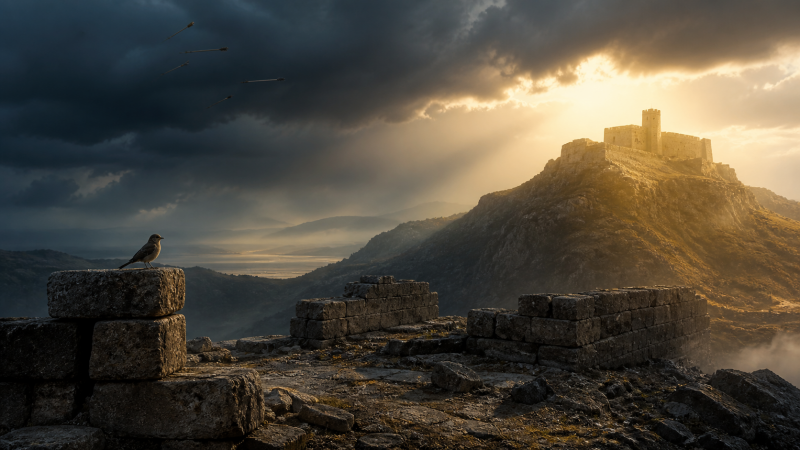
The advice given to David sounds sensible: “Flee like a bird to your mountain.” The wicked have bent their bows, fitted their arrows, and hidden in the shadows. This is not imaginary danger. The threat is close, deliberate, and difficult to locate.
Three details make retreat attractive. First, David can see the wicked acting. Second, their attack is subtle; they shoot from concealment, where they are hard to confront. Third, their efforts appear to be succeeding. The foundations themselves seem to be giving way.
Fear still argues in the same way. It tells Christians to stop praying because nothing appears to change, stop speaking because opposition is strong, and stop loving neighbours who may reject the truth. It encourages withdrawal into a protected religious circle where the troubles of the world can be kept outside.
There are times when physical escape from danger is wise. Psalm 11 is not a command to remain in an abusive or immediately life-threatening situation. David’s concern is deeper: he will not abandon trust, obedience, prayer, or faithful witness simply because evil looks powerful. Fear must not be allowed to turn prudence into surrender.
Look higher than the crisis
David answers the chaos on earth by looking towards heaven: “The Lord is in his holy temple; the Lord is on his heavenly throne.” Human foundations may shake, but the foundation beneath all reality has not moved. God has not abdicated. He has not been surprised or displaced.
The temple speaks of God’s presence with his people; the throne speaks of his power over all things. Together they assure us that he is both willing and able to keep those who take refuge in him. A crisis can narrow our vision until the immediate threat fills the whole horizon. Faith does not pretend the threat is small. It remembers that God is greater.
The cross is the strongest proof. Nothing has ever looked more like the triumph of evil than the crucifixion of the innocent Son of God. Yet even there, God remained on his throne, carrying out his saving purpose through what looked like utter defeat. If he ruled on that darkest day, he rules today.
The God who sees and tests
The enemies in Psalm 11 shoot from the shadows, but darkness cannot hide them from God. He observes humanity and examines every heart. Anonymous cruelty, secret corruption, whispered slander, and hidden violence are all fully visible to him. We may not know where every arrow came from. God does.
His examination also reaches the righteous. The language is that of testing precious metal. Trials are not meaningless interruptions to the Christian life. God can use them to expose false supports, deepen trust, purify desire, and make his people more like Christ.
That does not make suffering pleasant, and it does not require us to call evil good. It means pain is not wasted in God’s hands. The same heat that reveals the quality of gold can strengthen faith. We can ask not only, “How can I escape this?” but also, “How will the Lord keep and shape me through this?”
Justice will not be forgotten
Psalm 11 speaks plainly about God’s judgment. The wicked may flourish for a season, but they will not escape his sentence. His patience is not indifference, and apparent delay is not defeat. Every injustice will be answered by the Judge who sees perfectly and cannot be bribed, intimidated, or deceived.
This truth keeps us from two opposite errors. We do not have to despair as though evil will have the final word. Nor do we have to take vengeance into our own hands. We may continue doing good, seeking justice, praying, speaking truth, and entrusting the final verdict to God.
The face of God
The psalm ends with salvation: “For the Lord is righteous, he loves justice; the upright will see his face.” When God’s face seems hidden, faith holds on to the promise that his people will see him. Refuge is not merely protection from trouble. It is reconciliation with God and the hope of living in his presence.
We do not deserve that welcome. Left to ourselves, we stand among the guilty. Jesus opened the refuge for us by refusing to flee from the cross. He endured judgment in the place of sinners, was raised in vindication, and now reigns. Those who trust him are received rather than condemned.
So what can the righteous do when the foundations are destroyed? They can pray without giving up, love without retreating, speak without surrendering, and obey without panic. They can look beyond the arrows and the shadows to the Lord in his holy temple and on his heavenly throne. The foundations that matter most are still secure. In the Lord, we take refuge.
Add comment
Comments