

Romans 1:16–17 may be the most thrilling two-verse summary of the gospel in the entire Bible. Paul is about to spend the rest of his letter unpacking them. Here he gives us four reasons why he is not ashamed of a message the world considers foolishness—and why we should not be either.
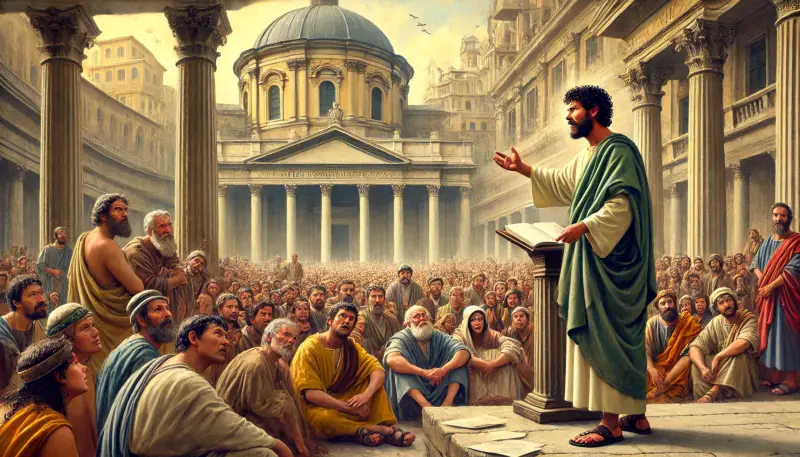
In verse 15 Paul has told us that he is eager to preach the gospel in Rome. Now in verse 16 he tells us why: he is not ashamed of the gospel. But why does he feel the need to say that? Perhaps some people thought Paul was ashamed to preach in Rome. He had talked a lot about coming but had never done it (v. 13). Maybe some were suggesting that the message of Jesus Christ crucified and risen was fine for the towns and villages out in the provinces, but not the sort of message you would preach in the sophisticated urban capital of the empire. Or perhaps Paul says this because it was a real temptation for his readers. These Christians in Rome were a tiny minority of believers in a vast, depraved city. Persecution from the government was an increasing threat—within a few years, the Emperor Nero would have Christians hunted down, tied to posts and set on fire to serve as lamp posts for his driveway, or dressed in animal skins and sent into the arena to be torn apart by wild animals.
That temptation faces us too, here in Ireland. We are a small minority—just a few handfuls here in church this morning, and there are not many churches meeting like this in Galway today. Our message flies squarely in the face of current thinking. It would be all too easy to believe the gospel in private but keep it to ourselves. Paul gives us at least four reasons why he refuses to do that.
1. Because of What the Gospel Is (v. 16)
The gospel is not a philosophy, not an idea, not a moral code, not good advice, not sentimental religious piffle to make us feel better. Paul says it plainly: the gospel is the power of God. The infinite power of Almighty God that created the universe is stored in this message. It might look weak and foolish—Paul himself calls it “the foolishness of the thing preached” in 1 Corinthians—but it throbs with divine energy.
It is striking that nothing else in the Bible, apart from Jesus Christ himself, is ever described as “the power of God.” As one writer puts it: God’s power is seen in erupting volcanoes, in the unimaginably hot boil of our massive sun, in a recently discovered star streaking through the heavens at 1.5 million miles per hour—and yet such wonders are never called “the power of God.” How powerful must the gospel be to deserve that title?
Think of splitting the atom. An atom is a tiny thing—a million or so fit on the head of a pin, invisible except under the most powerful electron microscopes. And yet incredible power holds together its protons, neutrons, and electrons. Who would ever have thought that so much energy is contained in something so apparently insignificant? The gospel is like that. People despise the Christian message, not realising that infinite power lies within it.
And this power is not destructive. Paul says it is the power of God that brings salvation. It saves, it restores what was broken, it brings life out of death, freedom, meaning, purpose, hope, peace, reconciliation, joy. Paul knows what he is talking about—he has seen this power up close, in his own life. The gospel turned him from an enemy of Jesus into a servant of Christ. And he has seen men and women once enslaved by demonic forces set free by this message.
Whenever we share the gospel, we are splitting the atom. The infinite power of God is being released. Do not be ashamed, do not be apologetic. Perhaps this very week you will share the gospel with someone, and because of those words, they will spend eternity in heaven instead of hell. There is no other message in the world that can do that. We are not ashamed to talk at length about our favourite football team, our children, the latest film—but none of those things is the power of God for salvation.
2. Because of Who the Gospel Is For (v. 16)
The gospel is the power of God for the salvation of everyone. Imagine you have the cure for cancer, but only some people qualify. How heartbreaking it would be to say to a terminally ill patient, “I have a cure, but it will not work for you.” Paul says the gospel can save anyone. It is for the Jew first, because they had been waiting for the Messiah for centuries, but it is also for the Gentile—in other words, for the whole world.
No matter where you go, no matter who you meet, they need to hear this message. That is why we go out onto the street on Saturday nights, why we have the bookshop, why we have a Go Team in the summer. Maybe we think there is no point talking to rich people in their big houses up in Taylor’s Hill. Maybe students think there is no point talking to that professor or PhD student who can argue rings around them. Maybe we think there is no point sharing with drug addicts or prisoners or the self-righteously religious. Paul says: do not think that for a moment. The gospel is the power of God for the salvation of everyone. There is a cure that is 100% effective in every case.
3. Because of How the Gospel Is Received (v. 16)
What if the cure for cancer existed but cost millions of euros, or could only be obtained by climbing to the top of Mount Everest? It may as well not exist for the vast majority of sufferers. Paul says the gospel is not like that. It does not depend on anything we do. It is received by faith—and he says it three times in two verses: “to everyone who believes”; “a righteousness that is by faith from first to last”; “the righteous will live by faith.”
This is what makes Christianity different from every other religion in the world. Every other religion says you must do something to be saved. Christianity alone says there is nothing you can do—God does it all, and you receive it as a free gift. Faith is simply the empty hand of the beggar held out to receive what God offers. There are no exams to pass, no money to pay, no moral bar to jump over.
Last night on the street, one man was very insistent that he wanted to pay for the free coffee and biscuits we were offering. It almost became an argument. We explained: it is free, it is a gift, there is nothing to pay, no strings attached. That is what we are all like with God, is it not? We want to contribute something to our salvation. But God says: receive it by faith. The young child can understand and believe the gospel. You do not have to be exceptionally brilliant or outstandingly good. The gospel is for everyone who believes.
4. Because of What the Gospel Shows (v. 17)
Why is the gospel message able to save? Because, Paul says, “in the gospel the righteousness of God is revealed.” The greatest problem of human beings is that we are not righteous. Our sins have created a barrier between us and God—and worse than a barrier, they have attracted his wrath. Unless something is done, this alienation will be irreversible and total, in hell.
And we cannot make ourselves righteous. All our righteousness is like filthy rags (Isaiah 64:6)—not our sins, but our very best efforts. Imagine falling into a muddy puddle, completely drenched, and trying to rub the mud off—but your hands are covered in mud too, and all you do is smear it around more. You pull out a handkerchief, but it is filthy as well. There is nothing you can do to make yourself clean. You need someone else to do it.
That is what the gospel does. It reveals a righteousness from God—the very thing we need but do not possess. Through Jesus Christ’s life, death, and resurrection, God provides his own perfect righteousness. It is not just a righteousness from God; it is the righteousness of God. There is no question of it not being good enough. God, through the life and death of his own Son, gives to his enemies who deserve death his own righteousness, so that we are reconciled to him forever.
No wonder Paul is not ashamed. Let us learn these verses by heart and go out with confidence and pride in this most awesome of truths.
This sermon is the fourth in our Romans series. It follows The Means of Grace and Peace (Romans 1:8–15) and continues with The Immoral Pagan (Romans 1:18–32).
Add comment
Comments